From fire camp to cooking classes, California students thrive in summer programs
California’s five-year-old, multi-billion-dollar Expanded Learning Opportunities Program has allowed school districts and charter schools to offer a vast array of enrichment activities outside the regular school day.
Most of the funds have been spent on before- and after-school activities during the school year. But the initiative also allows districts to offer a range of summer enrichment programs that go beyond traditional summer remedial and “credit recovery” classes.
Below are snapshots of some innovative programs, typically run by nonprofits or for-profit companies in partnership with local districts.
(Click the boxes to read more.)
Firefighting amid the oak-dotted rolling hills of Gold Country
By Karen D’Souza
Last summer, the residents of bucolic Calaveras County, nestled in the heart of gold country, fled from the terrifying flames of the Aero Fire, a fast-moving blaze that scorched 5,000 acres. The wildfire seared itself in the memories of all those who experienced its fury, especially children who had to evacuate.
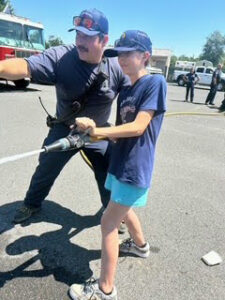
This summer, 28 elementary school students, from fourth to eighth grade, learned how to fight back against the flames in a two-week Career Technical Fire Camp.
“Fires are a part of life now,” said Louise Simson, superintendent of Mark Twain Union, noting that the burn scar from the fire edges right up to the Copperopolis Elementary campus. “You look up and there’s smoke in the sky. We all need to learn how to be prepared.”
To be sure, battling such a blaze requires equal parts courage and skill. That’s why these junior firefighters learned the ropes in hands-on hose and ladder drills. They also mastered the basics of life-saving techniques for water rescue and car extraction as well as how to give CPR, in a collaboration between Mark Twain Union and Bret Harte High School’s Fire Tech Program.
Funded in part by the Expanded Learning Opportunities Program and led by John Parks, a retired firefighter turned Career Technical Education (CTE) instructor, this kind of training can be a pathway into a growth sector as well as a vehicle for personal growth.
Jade Leonard says the camp helped her 10-year-old son, Noah, who has had diabetes since age 5, confront some of his vulnerabilities.
It “helped him overcome some fears surrounding emergency services,” said Leonard. “The impact of the program isn’t just on the career aspect, but it also teaches them structure, routine, discipline and hard work. Education is so important, but so are life skills.”
The camp culminated in a field trip to the Columbia Air Attack Base, where students got to climb aboard a colossal Cal Fire plane to let their dreams fly.
Kids learn crafts making, cooking and robotics in the Central Valley
By Lasherica Thornton

As part of a full-day camp in Tulare, Oak Valley Elementary students made 3D art, most recently creating their initials for their bedrooms.
Ella Gonzales, a rising first grader, measured the parts she needed to create her “E” initial. Upon encountering a problem, she exclaimed, “Have to have crafty solutions!”
ProYouth, a nonprofit that provides expanded learning opportunities to schools, runs the camp. The organization is contracted by 12 school districts to place camps in 62 schools across Tulare and Monterey counties — a reach that has expanded from offering after-school programs at three schools in 1998.
ProYouth offers full-day camps over the summer, from 7:30 a.m. to 5:30 p.m., with sports, crafts making, cooking, sewing and robotics at Oak Valley. Students participate in morning and afternoon clubs as well as academic enrichment programs. The clubs, or pathways, as ProYouth calls them, fall under either agriculture, health, art or computer science. For example, in the 3D art pathway, students have made piñatas and other paper-mâché projects, giving them the opportunity to build and design. The 3D art shows students that art is more than just paint, crayons and markers being used on paper, said Elva Solano, program director for the Oak Valley Union School District.
The 20-plus students in Oak Valley’s summer camp are a fraction of the more than 200 who attend the ProYouth-run programs during the school year; that’s about one-third of the students in the district. The one-school district received $800,000 a year from the state’s Expanded Learning Opportunities Program along with other state and federal funds for camp offerings. After-school programs include more clubs such as dance, foreign language, tech, and 4H for horseback riding, for example.
Lunch Bunch kids cook up yummy dishes in Compton
By Louis Freedberg

It’s hardly your typical school lunch. This summer, students in 18 elementary and middle schools in the Compton Unified School District gathered three times a week in classrooms transformed into makeshift kitchens to help make dishes reflecting the region’s ethnic and cultural diversity — among them Salvadoran pupusas, Thai soup, sushi, pizza, or just plain grilled cheese and tomato soup.
They’re enrolled in Lunch Bunch, one of over a dozen summer enrichment programs offered by Compton Unified to students tuition-free, with support from the state’s Expanded Learning Opportunities Program.
On the Lunch Bunch menu this week: scallion pancakes; a “garden delight” crudité of fresh vegetables; and nut-free Dubai chocolate strawberry cups, a Compton favorite, said Natasha Case, Lunch Bunch’s founder.
To assemble the meals, Lunch Bunch staff turn classrooms into portable kitchens, bringing with them electric frying pans, electric burners and plug-in blenders. Food has been preprepared in a central facility in Los Angeles’ Silver Lake district, a half hour away.
Students wear aprons with the brightly colored Lunch Bunch logo on the front. They can eat what they make, take it home with them or use the recipe to cook the dish at home with their families. Usually, said Case, “they eat it right there (in the classroom) because they are so excited to taste their own creation.”
The cooking classes, soon to be offered in 20 Southern California districts, mesh easily with core subjects in the regular school curriculum, Case explains.
Students learn about math concepts like fractions (through measuring, for example), science (how and why foods cook at different temperatures) and history (the origins of different dishes). Students also learn social-emotional skills like collaboration, communication and leadership, as well as an essential life skill: cleaning up their cooking areas after each class.
However, “we always want them to understand the big picture behind the lesson in a really fun and creative way that doesn’t feel burdensome and academic,” Case said.
Summer programs like these have been especially important during a stressful time for many families due to federal immigration threats in this heavily Latino district. As a result, said Jennifer Moon, Compton Unified’s executive director of educational services, some families were reluctant to participate. “But once they saw all the wonderful things happening through our Instagram or Facebook, they have been sending their kids,” she said.
Woodcraft Rangers serve over 15,000 students in L.A.
By Mallika Seshadri

Students across grade levels at a Woodcraft Rangers program in Los Angeles County counted down the days until a final field trip to a local water park.
Until then, some of the program’s youngest students molded coral out of clay, cut out paper sea creatures and crafted their own marine landscapes inside of zip-lock bags. Octopuses danced on a screen beside them.
The Woodcraft program has grown dramatically since the Covid-19 pandemic. What started out as a program geared more heavily toward high school students now serves over 15,000 students every day from 130 schools across the county, including several from Los Angeles Unified.
Relying on money from ELOP and 21st Century Community Learning Centers funds, Woodcraft offers both full-day summer school as well as enrichment programs that take place after other summer learning programs.
In many ways, the campuses — closed and guarded by security — are a bubble. Just outside, immigration raids are taking a toll on local communities in certain regions. Only 160 of the roughly 250 enrolled students are attending the summer enrichment program due to the increased ICE activity in one region of the county.
Woodcraft Rangers is minimizing the time parents need to spend getting out of their cars and is requiring every student to have two additional emergency contacts. Among staff, they’re providing training sessions and accommodations for those who might need to move to a different position or location.
Woodcraft is one of many programs serving students in the greater Los Angeles area. LAUSD has more than 90,000 students enrolled in its summer school program, and LA’s BEST is serving 168 LAUSD elementary schools. Further afield, the nonprofit Arc Imperial Valley is working with roughly 15 school partners across four districts in the Imperial Valley.