How to Build a Portfolio as a Student That Gets You Hired
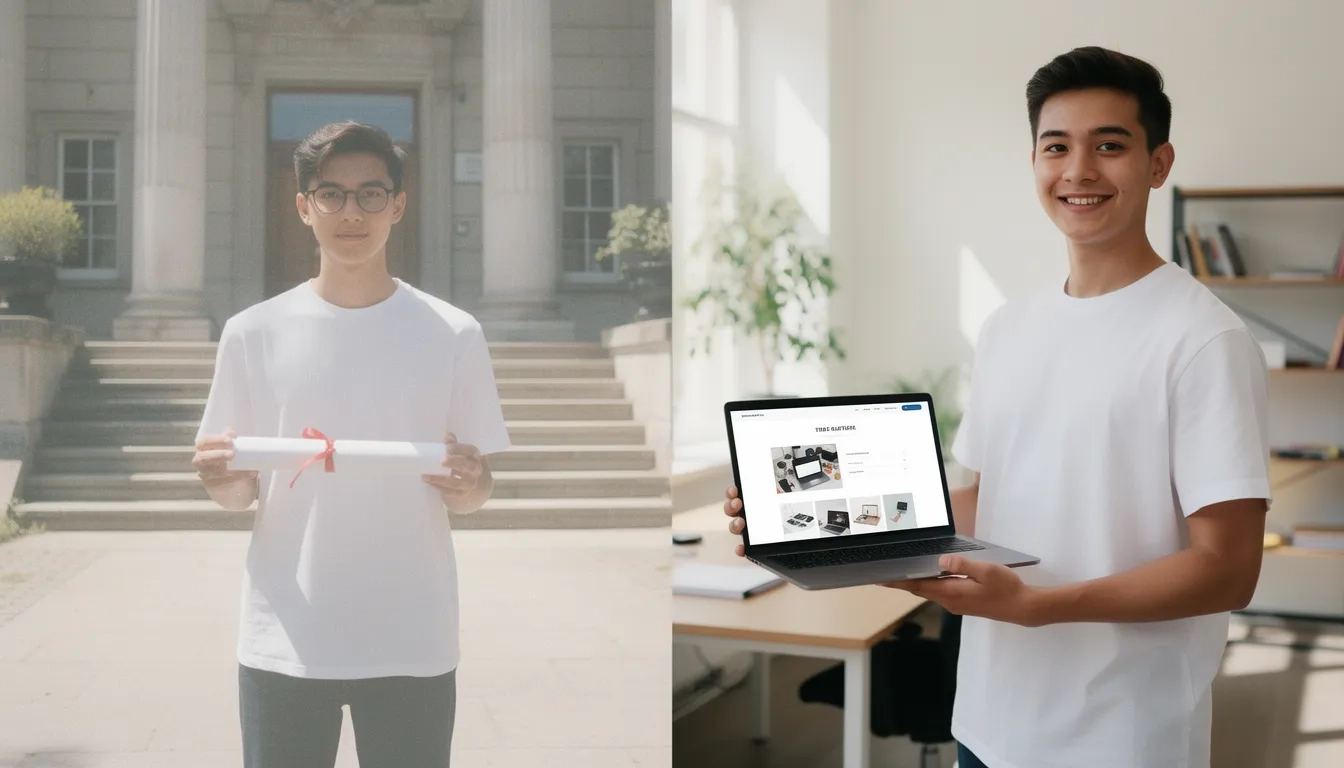
Recruiters spend 7 to 10 seconds scanning a resume before deciding whether to keep reading. A portfolio doesn't get scanned — it gets explored. That's the whole point.
The shift in hiring over the last few years is real. More employers, especially in tech, marketing, design, and consulting, have quietly dropped formal degree requirements from job postings and replaced them with work samples, portfolio reviews, and take-home assignments. A portfolio is how you answer that shift before the interview even starts.
Why "I Studied X" Isn't Enough Anymore
For decades, a degree from a recognizable school was the best proxy hiring managers had for predicting job performance. That proxy is eroding fast.
The credential-to-proof shift is happening across industries. Career platforms like Fueler have tracked that proof now consistently outweighs promise in early-career evaluations. Candidates with portfolios showing tangible outcomes get shortlisted at higher rates than those with comparable resumes and no work samples.
There's also a raw volume problem. Entry-level roles regularly attract 200-plus applicants per posting. When a recruiter has 200 tabs open, the candidate who links to a live project demo breaks the pattern. And most of your competition is still relying solely on resumes — which means building a solid portfolio is genuine differentiation right now, not just a nice-to-have.
The hiring signal has shifted from "here's what I studied" to "here's what I built." Your portfolio is where you make that case.
The Three Portfolio Modes
Not every portfolio looks the same. The right format depends on what you're going after, and trying to blend all three types is the most common structural mistake students make.
| Portfolio Type | Best For | Core Elements |
|---|---|---|
| Project-Based | Business, marketing, strategy | Case studies, problem-solving write-ups, measurable results |
| Creative Showcase | Design, media, branding | Visual-first layout, brief context per piece |
| Technical Proof | Engineering, data science, development | GitHub repos, live demos, performance metrics |
Pick one mode and build everything around that frame. If you're pursuing a marketing internship and a UX role simultaneously, make two portfolios. Once your work is documented, spinning up a second site takes a few hours — and it reads far more professionally than a mixed-bag approach that tries to speak to everyone.
A clear portfolio communicates a specific identity. A vague one communicates uncertainty. Employers hire for specific roles, not generalized potential.
The Write-Up Formula That Actually Works
Here's the part most students get wrong: they show the result without the reasoning. A screenshot of a completed dashboard is not a portfolio entry. A walk-through of why you structured the data the way you did, what failed in v1, and what improved in v2 — that's a portfolio entry.
The write-up format that consistently works across fields:
- Goal — What problem were you solving?
- Your role — What specifically did you own?
- Process — What did you try, and what informed your decisions?
- Deliverable — What did you actually produce?
- Results — What happened? Use numbers where you have them.
- Reflection — What would you do differently?
Step 6 is the one students skip. It signals maturity. Hiring managers looking at entry-level work aren't expecting perfection — they're looking for self-awareness and growth. Knowing what you'd change means you've thought critically about your own work, which is what most job descriptions ask for and few candidates actually demonstrate.
Keep each write-up to 300-400 words. Dice.com's reporting on tech hiring makes this concrete: instead of "improved application performance," write "reduced load time by 25 percent by optimizing database queries." Specificity is what separates a portfolio entry from a resume bullet.
Starting From Zero
"I don't have anything portfolio-worthy" is what students say right before listing three projects that absolutely count.
Class projects work. A group data analysis for an econometrics class is a legitimate portfolio entry if you define your role, explain your methodology, and show the output. Don't hide the academic context — name it, then show what you built inside it. Extern's portfolio research is clear: experience level matters far less than clarity and demonstrated thinking. Hiring managers aren't expecting you to have agency clients. They want to see how you work.
Beyond class work, here are legitimate sources of material:
- Volunteer your skills. Nonprofits, student clubs, and local organizations almost always need someone to build something: a website, a social media audit, an event budget model. Free, fast, and completely legitimate portfolio entries.
- Spec work. Redesign a brand you love. Write a content strategy for a local coffee shop. Build an API that solves a problem you actually have. The work is real even if the client is imaginary.
- Open source contributions. Even small pull requests — fixing documentation, resolving a minor bug — appear in your GitHub history and signal you can navigate someone else's codebase.
Students who begin collecting portfolio material in sophomore year have four to six documented projects by senior-year recruiting season. Students who wait until senior year have maybe one rushed piece and a lot of stress. The writing is on the wall: start before you feel ready. The material accumulates faster than you'd expect.
Platform Decisions
The platform question generates more anxiety than it deserves. Here's a practical breakdown.
GitHub alone is not a portfolio. It's a supporting link. Hiring managers outside engineering can't interpret a repository, and even technical reviewers want narrative context around the code. GitHub is necessary for technical roles and not sufficient for any of them.
For most students, the right platform depends on field:
- Framer or Webflow for design and UX — the portfolio itself becomes a design artifact
- Notion for a clean, minimal presentation in marketing or business roles (though it can feel generic if you don't customize the layout significantly)
- A hand-coded HTML/CSS site for developers — building your own portfolio counts as a portfolio piece
- Wix or Squarespace for non-technical students who need something professional and fast
One warning that matters: don't build on your university's servers or any platform tied to your student email. When you graduate, that URL disappears. Buy a domain. Namecheap sells them for about $12 per year. It's the cheapest career investment you'll ever make, and the alternative is sending a dead link to a recruiter at the worst possible moment.
For technical roles, Dice.com's analysis found that deployed projects on platforms like Netlify, Vercel, or GitHub Pages consistently outperform static screenshots in hiring manager reviews. A live demo someone can actually interact with is worth ten images of a UI.
Mistakes That Cost You Interviews
Leaving projects unfinished. A half-built app with broken navigation signals poor judgment, not ambition. If it's not ready to show, don't show it. Three polished entries beat six incomplete ones every time.
Template conformity. Canva portfolio templates look identical to every other student portfolio from your graduating class (and the three classes before yours). Customize the typography, change the color palette, restructure the layout. The whole point is differentiation.
Burying your best work. Lead with your strongest piece. The order is strategic, not chronological. Hiring managers who don't find something compelling in the first 30 seconds will close the tab — and they do it without guilt.
Fake testimonials. Lovable's analysis of common student portfolio errors flags fabricated employer quotes as a trust-killer. If you don't have real client or employer feedback yet, use metrics and outcome descriptions instead. Numbers don't lie.
The question isn't whether your portfolio is perfect. It's whether it exists. An imperfect live portfolio beats a polished one that's still being "worked on."
Relying on one format for every context. A PDF sent via email works fine for direct applications. A live website is better for networking and passive discovery. Know which format fits which situation and have both ready before you need them.
Keeping It Current
A portfolio you built sophomore year and never updated is almost as damaging as no portfolio. Plan to review it every 2-3 months — not necessarily to add new projects each time, but to confirm your strongest current work leads, that links still resolve, and that the skills you're claiming match the roles you're targeting.
Before any major application push — internship season, senior recruiting — do a targeted audit. Pull up 5-7 job descriptions for roles you want. Note the repeated keywords: tools, deliverable types, methods. Check whether your portfolio surfaces those terms. If a hiring manager can't tell within 60 seconds what you do and what you're good at, the structure needs work — not necessarily the projects themselves.
One thing most students miss: your portfolio's SEO metadata matters. When a recruiter Googles your name after seeing your resume — which happens more than you'd think — they'll land on your portfolio site before your LinkedIn profile. A clear page title and meta description in your site settings is the difference between a click and a scroll-past. Write it the same way you'd write a LinkedIn headline: specific, skill-forward, and human.
According to Fueler's guide to professional portfolios, updating every 2-3 months is the right baseline cadence. If you land a new project, add it immediately while the details are fresh. A reflection written three months after finishing a project is always thinner than one written the week you shipped it.
Bottom Line
- Start collecting portfolio material now, with whatever you have — class projects, volunteer work, and spec work all count when framed properly.
- Pick one portfolio mode (project-based, creative, or technical) rather than blending all three into a confusing mix.
- Use the Goal → Role → Process → Deliverable → Results → Reflection structure for every project write-up.
- Deploy on a platform you'll own after graduation, buy a real domain, and include live links wherever possible.
- Review and update every 2-3 months, especially before application seasons.
The single most important thing: ship it. A portfolio that exists and is 80% of what you envisioned will carry you further than one you're still polishing six months from now.
Frequently Asked Questions
How many projects should a student portfolio include?
Three to six projects is the right range. Extern's research identifies this as the sweet spot: enough to show range, few enough that every entry can be genuinely strong. Lead with your best project regardless of when it was completed, not when you feel most proud of it.
Do I need a portfolio if I'm applying to traditional fields like finance or consulting?
More than you'd expect, yes. Investment banks and consulting firms increasingly use take-home case studies and work samples in their recruiting processes. A portfolio showing quantitative analysis, financial modeling, or research work gives you a concrete artifact to reference in interviews rather than abstract claims about your abilities.
Can I include class projects, or do they need to be from real clients?
Class projects are completely legitimate. The key is framing: define your specific role within any group work, explain your methodology, and show your output with full context. Never imply something was a client project if it wasn't — that's a quick way to lose trust if a recruiter asks a follow-up question.
What's the difference between a portfolio and a GitHub profile for tech students?
GitHub shows commit history and code quality. A portfolio shows reasoning, context, and impact. You need both for technical roles. Think of GitHub as the evidence and your portfolio as the argument — one doesn't replace the other, and neither works as well without the other.
I'm a sophomore with almost nothing to show. Is it too early to start building?
It's actually the perfect time. Students who begin building portfolio material in their second year have the most documented, polished work by the time senior recruiting starts. Use this year to take on one or two projects specifically for portfolio value — a volunteer build, a spec piece, a personal tool you actually use day-to-day.
Should I put my GPA on my portfolio?
Only if it's above 3.7 and you're in a field where GPA carries real weight (finance, consulting, some engineering roles). Otherwise, let your work speak for itself. A strong project write-up with quantified outcomes communicates capability more directly than a number ever will.