Employer-Sponsored Scholarship Programs: What You Actually Need to Know
About 47 percent of employers offer some form of educational benefit. Yet industry data consistently shows that only 2 to 5 percent of eligible employees actually use them. For scholarship programs specifically, the gap is even wider — millions of dollars go unclaimed every year because workers don't know the programs exist, or because no one explained the difference between a scholarship and a reimbursement plan. That difference matters more than most people realize.
What Employer-Sponsored Scholarships Actually Are (And Aren't)
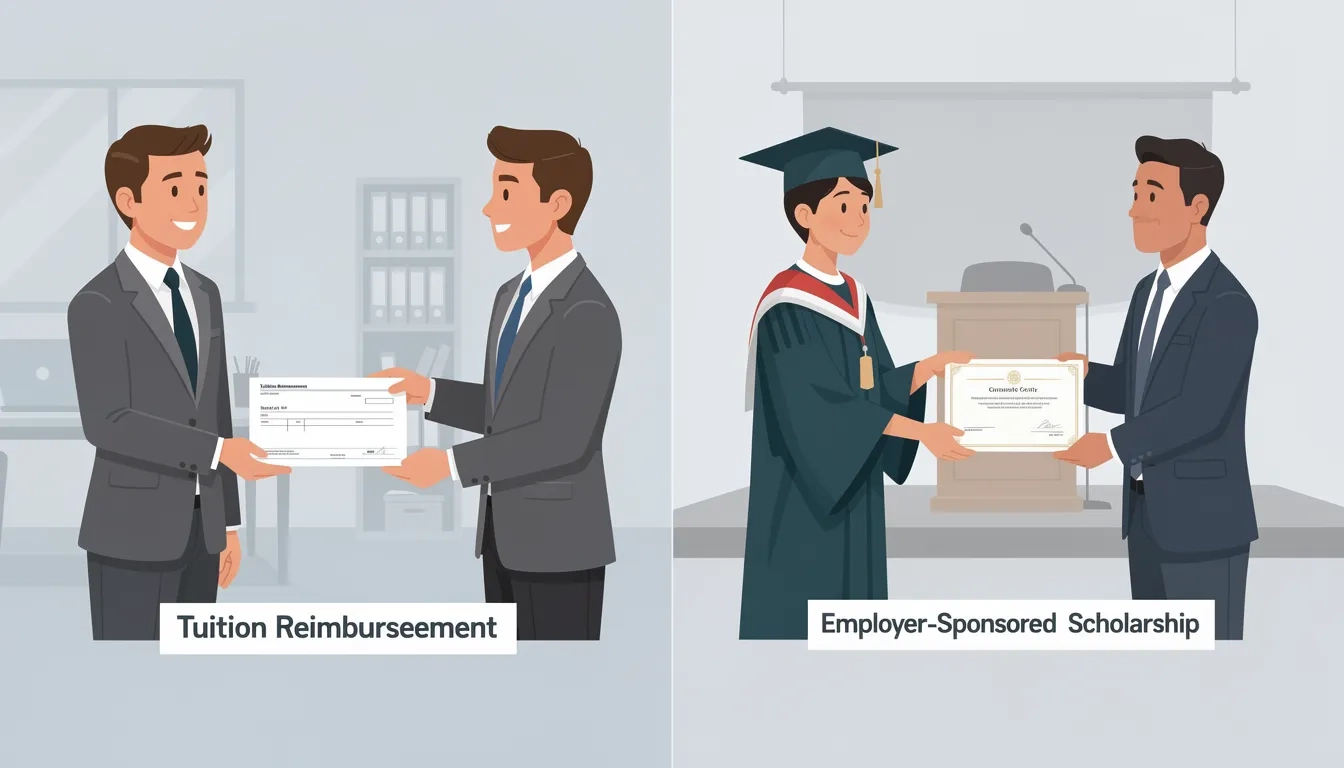
Before anything else, let's clear up the confusion between scholarships and tuition reimbursement. They are not the same thing.
Tuition reimbursement requires the employee to pay out-of-pocket first, complete the course, and then submit receipts. Most programs also include clawback clauses — leave within twelve months, and you repay some or all of what you received. It's a loan with homework.
A scholarship is a grant. The award is made, the money goes to the school, and the recipient owes nothing back. No receipts, no payback clauses.
There are two distinct types of employer scholarship programs:
- Employee scholarships — for workers pursuing degrees or credentials themselves
- Dependent scholarships — for employees' children, and sometimes stepchildren or legal dependents
Both serve different workforce goals. Dependent programs tend to resonate most with mid-career employees who have college-aged kids at home. Self-directed programs appeal to early-career workers building credentials. Some companies run both.
A third variation — community scholarships through a corporate foundation — is open to the general public, with employment at the company as one of many eligibility criteria. These lean charitable in nature, though they carry recruitment and brand value too.
The Tax Picture
This is where things get interesting, and where the IRS requires precision.
IRS Section 117 covers qualified scholarships. Under this rule, scholarship amounts applied to tuition, required fees, books, and course supplies are tax-free to the recipient. Room and board are the exception — if an award includes those costs, that portion becomes taxable income to the student.
For employer programs, the recipient pays no income tax on the scholarship as long as it goes toward qualified expenses and isn't functioning as disguised compensation (more on that in a moment).
Section 127 is a separate rule. It covers formal employer educational assistance plans — the reimbursement-style programs where the company pays up to $5,250 per employee per year in tax-free benefits. Scholarships for employee dependents fall under Section 117, not 127, so the $5,250 annual cap doesn't apply to dependent programs.
Here's a side-by-side look at how the main structures compare:
| Program Type | Tax-Free to Recipient | IRS Code | Annual Cap | Repayment Required |
|---|---|---|---|---|
| Dependent scholarship | Yes (tuition/fees only) | Section 117 | None specified | No |
| Employee self-directed scholarship | Yes (tuition/fees only) | Section 117 | None specified | No |
| Employer educational assistance plan | Yes | Section 127 | $5,250/year | No |
| Standard tuition reimbursement | Partially (up to $5,250) | Section 127 | $5,250/year | Often (clawback) |
For the employer, scholarship payments made through a properly structured private foundation are typically deductible as charitable contributions. Direct corporate programs may qualify as business expense deductions. Either way, no payroll tax runs through these awards.
The Compliance Rules That Trip Companies Up
Most companies that get this wrong aren't being dishonest. They just don't know the IRS requirements, which are specific and non-obvious.
"Scholarships must provide evidence that they are awarded to further the recipients' education rather than to compensate employees." — IRS guidance on company scholarship programs
The independent committee requirement is the biggest surprise for first-time program builders. The IRS mandates that selection decisions be made by people genuinely independent from the company, its private foundation, and the employer. HR staff cannot sit on the committee. Neither can executives or foundation board members. The selection panel must operate free from any employment-related considerations.
The percentage test is equally important. Revenue Procedure 76-47 — the IRS framework governing company scholarship programs — limits how many awards can flow to employee-related recipients. Generally, scholarship grants to employees or their relatives should not exceed 25 percent of the eligible applicant pool. Exceed that threshold, and the IRS may reclassify the entire program as disguised compensation. Retroactively.
The purpose test runs underneath everything else. Every award must primarily serve the recipient's educational advancement. If an analysis of who receives awards reveals that high performers' kids consistently win, that's a red flag. Selection criteria must be objective: academic merit, financial need, field of study, community involvement.
Seeking advance IRS approval is optional, but recommended for programs expecting to distribute more than $50,000 annually. The process involves submitting documentation to the IRS Exempt Organizations Division showing the program meets the three-condition standard in Revenue Procedure 76-47. Yes, it involves significant paperwork. But it creates a defensible record if the program is ever questioned.
Why Companies Actually Invest in These Programs
Retention is the most honest answer. A company that helps an employee's teenager get into college without financial catastrophe builds loyalty that a salary adjustment cannot match. Mid-career workers — the ones with the institutional knowledge and client relationships a company most wants to keep — tend to value dependent benefits more than almost any other perk.
Accenture's analysis of educational assistance programs found that for every dollar companies spend, they save an average of $1.29 in recruiting costs. That figure covers the broader category of educational benefits, but the logic applies directly to scholarship programs: reducing turnover among experienced workers is dramatically cheaper than replacing them.
Recruitment differentiation is the second driver. Nearly 60 percent of American families report depending on scholarships to make college affordable, according to Edcor's research. A company with a dependent scholarship program is offering something tangibly different from most competitors. That shows up in offer acceptance rates.
Third: skills pipeline development. Some programs require applicants to declare a field of study, effectively nudging award decisions toward engineering, nursing, or finance — fields where the sponsoring company has open roles. Chick-fil-A's Remarkable Futures scholarship awards between $1,000 and $25,000 to restaurant team members pursuing higher education, and the program has run continuously since 1973. Amazon's Future Engineer scholarship issues up to $40,000 to 400 students annually, targeting computer science majors from underrepresented backgrounds.
Finally, diversity pipeline goals. Programs built with intentional criteria can reach students from underrepresented communities heading into fields where representation is thin. This works better when the scholarship criteria connect to specific field-of-study goals rather than vague broad language in the eligibility requirements.
How to Set One Up
The first structural decision is: run the program directly through the company, or through a private foundation?
Direct programs are simpler to launch. The company administers grants through HR or a third-party administrator like Edcor. Tax deductibility runs through business expense treatment. The tradeoff is more IRS scrutiny — proving the program isn't employee compensation when it's administered directly is harder than when a foundation does it.
Foundation-based programs require more upfront complexity (nonprofit formation, governance obligations, annual Form 990 filings). But charitable deductibility is cleaner, the independent-committee requirement is easier to demonstrate structurally, and the IRS track record for advance approval is stronger.
Here's a practical setup sequence:
- Define scope: employees only, dependents only, or both?
- Set award structure: one-time grant, multi-year renewable, merit-based, or need-based?
- Draft a written program document with selection criteria that carry no employment-preference weighting
- Appoint an independent selection committee — no HR, no executives, no foundation officers
- Establish internal percentage tracking to stay within the 25 percent guideline for employee-related recipients
- Consider IRS advance approval if annual awards will exceed $50,000
- Partner with a third-party administrator if internal compliance capacity is thin
Smaller companies tend to underestimate the administrative overhead. Running a lean program through a firm like Edcor typically reduces compliance risk and operational burden, especially for companies under 500 employees without dedicated benefits staff.
Finding and Applying as an Employee or Dependent
If you're an employee, ask HR directly whether a program exists. Do not assume the absence of an announcement means no program. Many employer scholarship programs are buried in benefits portals or mentioned once during onboarding and never again.
For dependents searching broadly, BigFuture from College Board (bigfuture.collegeboard.org) maintains a searchable database of employer-sponsored scholarships. Scholarships360 also aggregates current corporate programs with award amounts and deadlines.
A few things worth knowing before applying:
- Application timelines run early. Most programs close in fall of the student's senior year of high school, not spring. Missing the deadline by even a week is usually fatal to the application.
- Essays carry significant weight. Corporate selection committees often weight personal narrative heavily, particularly for service-industry companies whose cultures emphasize team values.
- Renewal terms vary. Some awards are one-time; others renew annually if the student maintains a specified GPA or full-time enrollment. Know the terms before accepting.
- Stacking is possible. A student whose parent works for a supplier to a larger corporation might be eligible for the employer's own program, an industry trade association scholarship, and the corporate program simultaneously.
Don't leave money on the table because you assumed someone would have told you about it.
Bottom Line
Employer-sponsored scholarship programs are one of the most underused tools in the employee benefits space. HR teams often don't know the IRS rules well enough to launch one confidently. Employees don't know to ask. Both sides lose.
- For employers: A dependent scholarship program delivers real retention value among mid-career workers, carries favorable tax treatment, and differentiates your offer in competitive hiring markets. Get the independent committee structure right and consider IRS advance approval for any meaningful program size. The compliance requirements exist — ignoring them creates retroactive tax liability.
- For employees and students: Ask HR whether a program exists. Check BigFuture's scholarship search. Start applications in fall of senior year. Understand renewal requirements before accepting an award.
- The single most important distinction: Scholarships require no repayment and carry no clawback clauses. That makes them worth more than a comparable dollar amount of tuition reimbursement — a fact that most employees, and surprisingly many HR professionals, don't fully appreciate.
Frequently Asked Questions
Are employer-sponsored scholarships taxable income to the recipient?
Generally no, if the award is used for qualified education expenses — tuition, required fees, books, and course supplies. Room, board, and personal living expenses are excluded from this treatment and would be taxable if included in an award. This protection comes from IRS Section 117 and applies regardless of whether the scholarship originates from an employer or another source.
What's the real difference between a scholarship and tuition reimbursement?
A scholarship is a grant made before the student pays — no receipts required, no repayment obligation. Tuition reimbursement means the employee pays out-of-pocket first, completes coursework, submits documentation, and then receives a check. Most reimbursement programs also include clawback clauses requiring repayment if the employee leaves within a set period. For the recipient, a scholarship is almost always the better deal.
Can a company's scholarship program legally prioritize employees' children?
Yes, with limits. The IRS permits employment connection to function as an initial screening criterion, but it cannot drive the final selection. An independent committee must make award decisions based on merit, need, or other objective factors. If employee-related recipients make up more than roughly 25 percent of total awards, the IRS may reclassify the program as disguised employee compensation — which removes the tax-exempt status from every award made under it.
Do small businesses qualify to run scholarship programs?
Yes. There's no minimum company size. Small businesses can run direct programs or partner with a community foundation to administer awards. The main practical challenge is administrative overhead: at lower award volumes, per-grant compliance and reporting costs are proportionally higher. Third-party administrators can help, but they add cost that only pencils out once the program reaches a certain scale.
How does a student find out if their parent's employer has a scholarship program?
The fastest route is asking HR directly. Many programs are not broadly advertised. Checking the employee benefits portal and any onboarding materials is the second step. For searching corporate programs more broadly, the BigFuture database from College Board and Scholarships360 both maintain searchable, regularly updated lists of corporate and employer-sponsored scholarships with current deadlines and award details.
What is Revenue Procedure 76-47, and does it still apply?
Yes, it still applies. Revenue Procedure 76-47 is the IRS framework that specifies the conditions company scholarship programs must meet to qualify for tax-exempt treatment. It covers the independent committee requirement, the percentage limits on employee-related recipients, and the objective selection criteria standards. Any company building a new program — or auditing an existing one — should treat this document as the primary compliance reference, ideally alongside a tax attorney familiar with nonprofit and employee benefit regulations.