GPA Requirements for Scholarships: What You Actually Need to Win
Most students think a 3.5 GPA secures scholarship money. It doesn't, at least not automatically. The Coca-Cola Scholars Program lists a 3.0 as its minimum GPA — but the average winner carries a 3.8 or higher, competing among 90,000+ applicants for just 150 spots. The minimum gets you in the door. The typical winner is having a completely different conversation.
That gap between "minimum required" and "competitive enough to win" is where most scholarship searches go wrong.
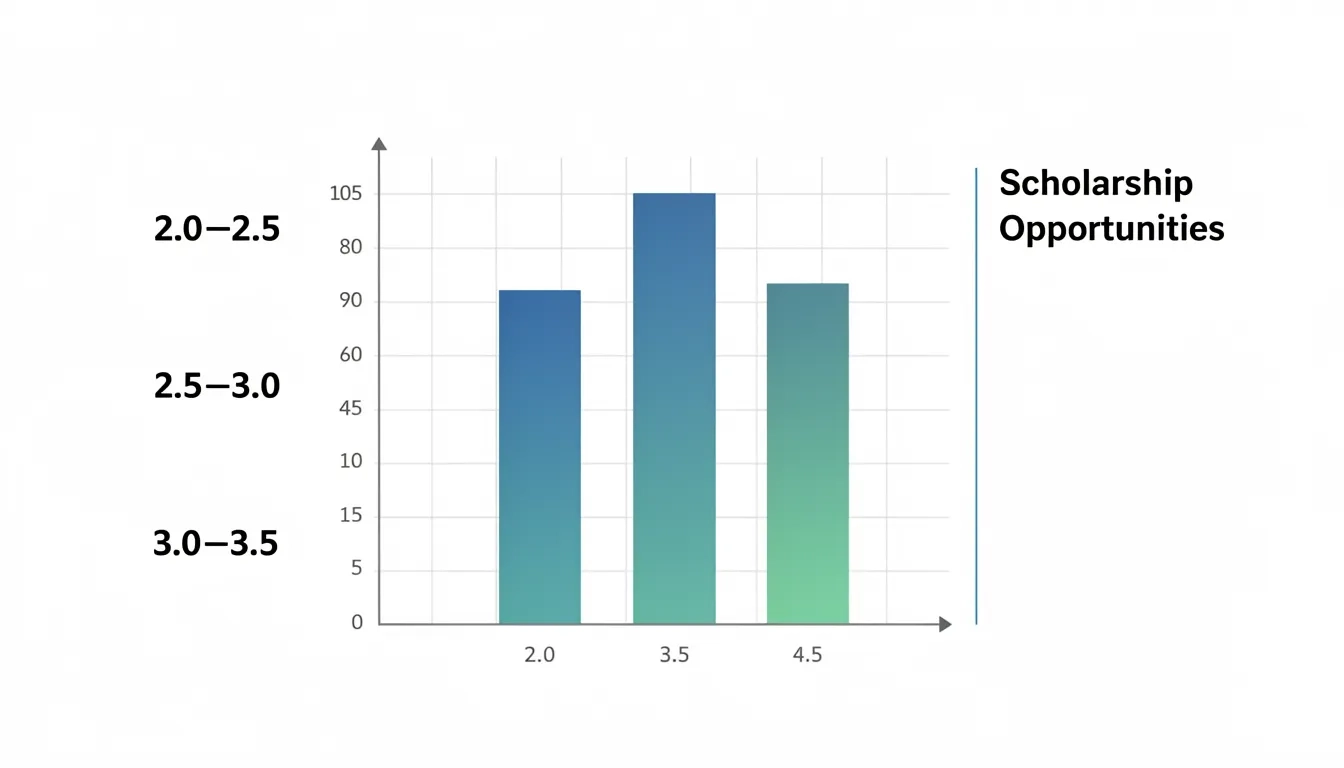
The GPA Tiers That Actually Determine Your Options
Scholarship money doesn't flow evenly across the GPA scale. Here's how it actually breaks down by tier:
| GPA Range | Typical Access | Estimated Annual Award |
|---|---|---|
| Below 2.5 | Need-based aid, essay contests, niche awards | Varies widely |
| 2.5–2.9 | Some institutional grants, community scholarships | $1,000–$5,000 |
| 3.0–3.4 | State programs, entry-level merit awards | $3,000–$10,000 |
| 3.5–3.7 | Competitive private merit scholarships | $10,000–$25,000 |
| 3.8–4.0 | Full-ride and presidential awards | Up to $75,000/year |
The 3.0 threshold is where state programs live. Georgia's HOPE Scholarship pays roughly $5,000 per year at a 3.0. Florida's Bright Futures Medallion also starts there, paired with a minimum 1210 SAT or 25 ACT. These are automatic — meet the criteria and you qualify without a separate competitive application.
The 3.5 line is where competitive private awards open up. Below it, you're mostly working with institutional grants that universities calculate algorithmically from your transcript. Above it, you're eligible for named, competitive scholarships with separate applications, essays, and interview rounds.
At 3.8 or above, full-ride programs become realistic targets. Georgia's Zell Miller Scholarship requires exactly a 3.7 and covers full tuition at public universities. The University of Alabama's Presidential Scholar award requires a 4.0 plus a 1540 SAT or 35 ACT. These programs exist specifically to recruit top students and will price the offer accordingly.
What "Minimum GPA" Actually Means
Here's the thing nobody says clearly enough: listed minimum GPA is not the same as winning GPA.
The Gates Scholarship sets its minimum at 3.3. Average recipient GPA? Above 3.9. Three hundred awards nationally, tens of thousands of applicants. The 3.3 bar functions as a filter to clear out clearly ineligible applicants — not as a target. Apply with exactly a 3.3, and you're technically eligible, not competitive.
The Coca-Cola Scholars Program makes this explicit once you do the math. 3.0 minimum, 90,000+ applicants, 150 winners. Nobody wins with a 3.0. They win with a 3.8+ and an extraordinary record of leadership and community work. The GPA requirement is the ticket to the arena; what wins the match is everything else.
The minimum GPA tells you whether you can apply. The average winner's GPA tells you whether you can actually win.
When researching any scholarship, hunt for two numbers: the stated minimum and the reported average GPA of past recipients. Some programs (like the Jack Kent Cooke Foundation, which awards up to $55,000 per year) list a "typically 3.5+" note — which is honest shorthand for "this is approximately where winners cluster." That's far more useful than a formal minimum. Notably, only 43% of scholarships in the Scholarships360 database even state a formal GPA requirement. For the other 57%, GPA still influences competitiveness; you just have to infer the bar from past recipient profiles.
Named Programs and Their Real Benchmarks
Concrete data is more useful than generalizations, so here are actual requirements:
Automatic university awards (no separate application needed):
- University of Alabama Presidential Scholar: Full tuition, 4.0 GPA + 1540 SAT or 35 ACT
- Arizona State Presidential Award: $13,500/year for a 3.8+ GPA and 1360 SAT
- Arizona State Dean's Award: $9,500/year, accessible at 3.0–3.49 GPA with 1140 SAT
- University of South Carolina McKissick Scholarship: $10,000/year at 3.5 GPA
State scholarship programs:
- Georgia HOPE Scholarship: 3.0 high school GPA, roughly $5,000/year
- Georgia Zell Miller Scholarship: 3.7 GPA, full tuition at public universities
- Massachusetts Paul Tsongas Scholarship: 3.75 minimum, full tuition waiver at state schools
Competitive national awards:
- Burger King Scholars Program: 3.5 minimum, awards ranging from $1,000 to $60,000
- Dell Scholars Program: 2.4 minimum (explicitly designed for students who've overcome hardship)
- Goldwater Scholarship: STEM-focused, no stated minimum but 3.8+ is standard among winners
One non-obvious data point worth knowing: a 3.5 GPA paired with a 1400 SAT tends to generate more merit money than a 3.9 GPA paired with a 1200 SAT. Universities run merit award models that weigh both factors simultaneously, and strong test scores can compensate for a slightly lower GPA in ways the reverse rarely matches — even at schools that call themselves test-optional.
The Renewal Trap That Kills Awards After Year One
Getting the scholarship is step one. Keeping it is the problem most students never prepare for.
Research consistently shows the average freshman GPA drops 0.3 to 0.5 points from their high school GPA. A student who graduated with a 3.7 often finds themselves at a 3.2 by December. Whether that triggers a scholarship review depends entirely on the renewal threshold — and many students have no idea what theirs is until a warning letter arrives.
Renewal requirements vary significantly by program:
- Most state programs (HOPE, Bright Futures) require a 3.0 cumulative GPA each year
- Many university merit scholarships check per-semester GPA, not cumulative
- Presidential-level university awards often require 3.5–3.8 for renewal
- Federal Pell Grants require satisfactory academic progress at a 2.0 floor
The difference between cumulative and per-semester checking matters more than most students realize. A rough fall semester drags down cumulative GPA slowly. But if your scholarship is reviewed each semester independently, one bad term ends the award immediately — even if your overall track record looks fine.
When GPA slips, most programs follow a three-stage sequence:
- Warning — you're notified but continue receiving funds
- Probation — funding continues for one semester, with a recovery plan required
- Termination — award ends; re-application may or may not be possible
Schools allow formal appeals more often than students realize, particularly when GPA dropped due to a documented medical situation or family emergency. These appeals succeed at a reasonable rate — largely because so few students bother to file one.
When GPA Isn't the Primary Filter
Not every scholarship category runs on academic performance.
Athletic scholarships operate under different rules. The NCAA requires a minimum 2.0 GPA (calculated on core courses only) for Division I and II eligibility. That's a compliance floor, not a selection criterion — scholarships go to athletes who help teams win, not students with the highest GPA on the squad. About 2% of high school athletes receive any athletic scholarship money at all, which makes this a poor planning target for most students.
Need-based programs treat GPA as a viability check, not a merit measure. The Dell Scholars Program's 2.4 minimum confirms a student can handle college coursework. The real selection criteria are income level, first-generation college student status, and evidence of persistence against adversity.
Niche and community scholarships — credit unions, local Rotary clubs, employer programs, professional associations, religious institutions — often set bars at 2.5 specifically to widen the pool. Students chasing national awards routinely overlook these. That's leaving money on the table. A $3,500 local scholarship (small applicant pool, no competition from 90,000 other students) funds a semester of textbooks and takes the same hour of effort as a scholarship you'll never win.
How to Build Your Strategy Around Your GPA
The right approach looks different depending on where you're starting from.
If your GPA is 3.8 or above: Start with automatic university merit awards — no separate application, and they can stack with other aid. Then build a list of 5–8 competitive national scholarships matched to your specific strengths (STEM students should research the Goldwater Scholarship; public service-focused students should look at the Truman). Your bottleneck at this GPA isn't the number — it's the essay, leadership narrative, and recommendation quality.
If your GPA is 3.5–3.7: Research the automatic merit thresholds at every school on your list before paying application fees. Some schools offer $10,000–$25,000/year that triggers at exactly 3.5, which should directly influence where you apply. Apply to 15–20 competitive private scholarships in this range, and plan ahead for renewal requirements before you ever set foot on campus.
If your GPA is 3.0–3.4: State programs are the most reliable path. Confirm eligibility for your state's equivalent of HOPE or Bright Futures. For private scholarships, target community-level and essay-heavy awards where the 3.1 vs. 3.4 gap carries less weight than the application itself.
If your GPA is below 3.0: Need-based aid, the Dell Scholars Program, and trades or vocational scholarships are your primary tools. Identify what non-academic strengths you can document — work experience, community involvement, demonstrated resilience — and search for scholarships built around those factors specifically.
Across all tiers, applying to 35–50 scholarships total, spread across reach, target, and safety categories, dramatically outperforms the average student who submits eight applications and treats each rejection as a verdict on their chances.
The Grade Inflation Problem
Average high school GPA climbed from 3.0 in 2009 to 3.38 by 2017 — and pandemic-era grading pushed that trend further. A 3.5 GPA carries less signal than it did 15 years ago, and scholarship reviewers know it. That's part of why course rigor has gained weight in merit evaluations even at test-optional schools.
A 3.6 built on six AP courses and dual enrollment reads differently than a 3.8 built on standard coursework. Scholarship committees, especially at institutional levels, can see the transcript. The student who chose harder courses and earned a slightly lower grade for it often comes out ahead in the evaluation — because the reviewer isn't just reading a number, they're reading context.
If you're in 10th or 11th grade and have a choice between easier classes that protect your GPA or harder classes that might bring it down slightly, the harder classes are usually the better bet for scholarship competitiveness. You'll build a more defensible application narrative and signal academic ambition more clearly.
Bottom Line
- Look up two GPA numbers for every scholarship you target: the stated minimum and the typical GPA of past winners. Build toward the second one.
- Research automatic university merit thresholds before paying application fees — some schools publish $10,000–$25,000/year awards that trigger without a separate application.
- Read your scholarship's renewal requirements before cashing the first check. Know whether the program checks per-semester or cumulatively, and plan your college course load around that floor.
- Don't dismiss niche and community scholarships. Low competition makes them among the highest-value applications you can submit, especially if your GPA sits in the 3.0–3.4 range.
- Course rigor matters. A slightly lower GPA earned through genuinely hard classes often outcompetes a higher GPA from lighter coursework, because reviewers read transcripts, not just numbers.
Frequently Asked Questions
What is the minimum GPA needed for most scholarships?
Most merit-based scholarships set a minimum around 3.0, but individual programs vary from 2.4 (Dell Scholars Program) to 3.75 (Paul Tsongas Scholarship in Massachusetts). Only 43% of scholarships formally state a GPA requirement at all. For the rest, competitiveness depends on what the average applicant pool looks like — which you can often find by looking at past recipient profiles.
Can you get a scholarship with a 2.5 GPA?
Yes. Need-based programs including federal Pell Grants, community organization awards, and essay-based scholarships with no stated GPA minimum are all accessible at 2.5. The Dell Scholars Program explicitly accepts a 2.4 minimum for students who demonstrate financial need and documented persistence. Merit scholarships thin out considerably below 3.0 but don't disappear entirely.
Is it a myth that you need a 4.0 GPA for a full scholarship?
Mostly yes. Some automatic university awards (like the University of Alabama Presidential Scholar) do set that bar, but most competitive national full-ride programs don't formally require a 4.0 — they just tend to attract applicants who happen to have one. A 3.8 is functionally competitive for most full-ride programs, and a strong total application package can make a 3.6 competitive at the right schools.
What happens if my GPA drops below my scholarship's renewal threshold?
Most programs follow a warning-then-probation-then-termination sequence before revoking aid, so you typically get at least one semester of notice. If the drop coincided with a documented medical situation, family emergency, or bereavement, file a formal appeal. Programs grant these more often than students expect — simply because most students never submit one.
Does taking harder classes hurt my scholarship chances if my GPA dips?
No — it usually helps. Scholarship reviewers read transcripts, not just GPA numbers. A student who earns a 3.6 across AP and dual enrollment courses signals something meaningfully different than a 3.9 from all standard coursework. At test-optional schools especially, rigorous course selection paired with solid test scores often unlocks more merit money than GPA alone would predict.
How many scholarships should I apply to?
More than most students apply to. A target of 35–50 total applications — split across 10–15 competitive reach scholarships, 15–20 realistic target awards, and 10–15 safety-level community awards — gives you a statistically reasonable shot at landing multiple offers. Students who apply to fewer than 10 and receive little funding often conclude scholarships aren't worth the effort. The real issue is almost always sample size.
Sources
- What GPA Do You Need For a Full Scholarship in 2026? | Bold.org
- Merit Scholarships by GPA: What You Can Earn at Every GPA Level | LevelAll
- Top Scholarships Based on GPA | Scholarships360
- GPA For Scholarships: Minimum Requirements and Thresholds | GradeCalculatorTools
- What GPA Do You Need to Get a Full Scholarship? | Fastweb