How to Get Scholarship Money as a Graduate Student
Most first-year graduate students leave money on the table. Not because the funding doesn't exist — there's more than most people realize — but because they look in the wrong places or start too late. A doctoral student who understands the system can walk away with full tuition coverage plus $25,000 or more in annual stipend. The student in the next seat might borrow $80,000 for the same degree. The difference between those two outcomes is almost entirely about knowing which mechanisms exist, when the deadlines hit, and being willing to ask.
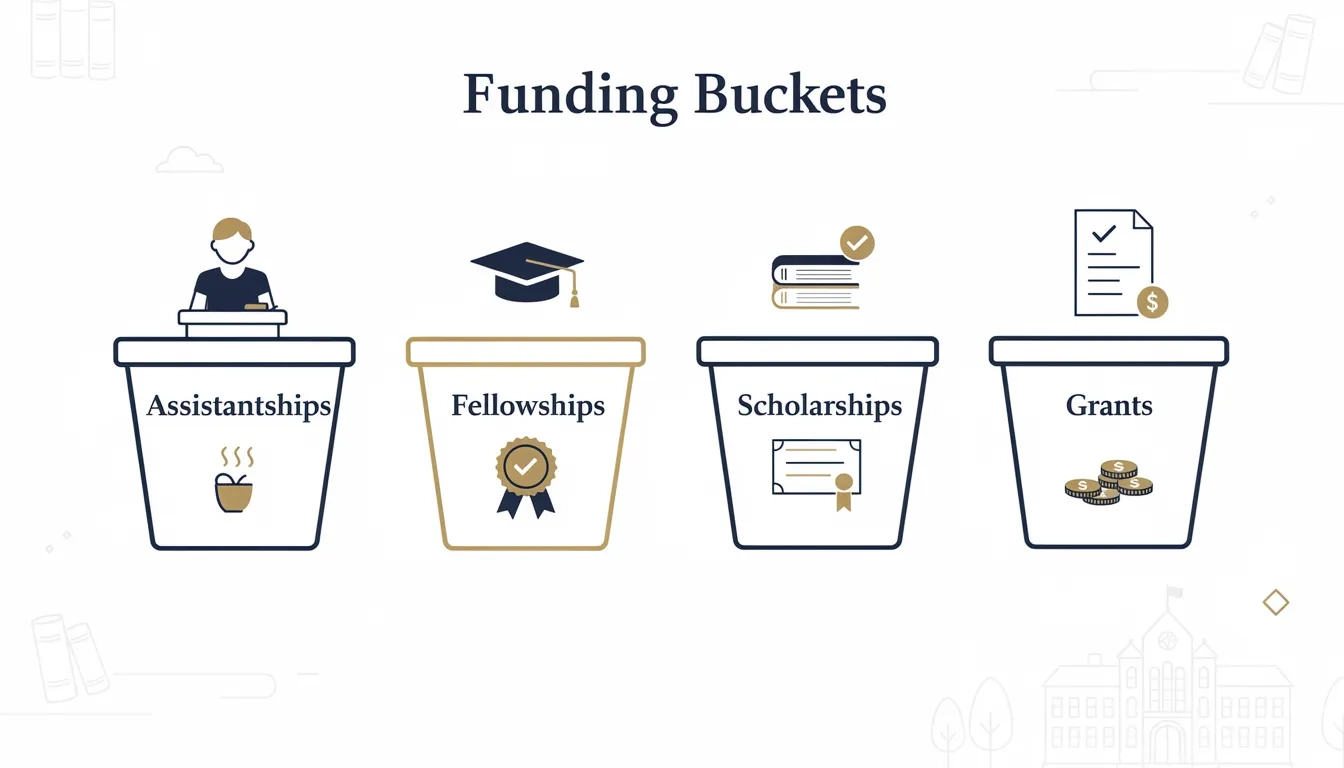
The Four Buckets of Graduate Funding
Before applying anywhere, it helps to understand how graduate money actually flows. There are four distinct mechanisms, and the weight of each depends heavily on your degree type and field.
Assistantships are the workhorse of doctoral funding. In exchange for 15-20 hours per week — teaching undergrads, supporting faculty research, or staffing a graduate office — programs offer a tuition waiver plus a monthly stipend. Teaching assistantships (TAs) pay reliably regardless of your advisor's grant status. Research assistantships (RAs) tie your funding directly to a faculty member's active grants, which can accelerate your dissertation but also means your income is linked to that specific funding stream.
Fellowships are merit-based awards from external organizations, government agencies, or universities. They require no work in return and can stack on top of an assistantship. The NSF Graduate Research Fellowship Program provides $37,000 annually in stipend plus $16,000 to cover tuition and fees for three years — more than $159,000 in total support for qualifying STEM students.
Scholarships are one-time or annual awards from private foundations, professional associations, and institutions. They range from a few hundred dollars to $90,000 and tend to have higher acceptance rates than flagship fellowships. Grants typically fund specific research projects rather than students directly — but many grant budgets include a student support line, so a faculty member's active research funding often translates into an RA position you can occupy.
| Funding Type | Who It's For | Work Required | Typical Value |
|---|---|---|---|
| Teaching/Research Assistantship | PhD students primarily | Yes (15-20 hrs/week) | Tuition + $15K–$35K/yr |
| NSF GRFP Fellowship | STEM PhD/master's (U.S. citizens) | No | $37K stipend + $16K education |
| University Internal Fellowship | Any grad student | Sometimes | Varies widely |
| External Scholarship | Any grad student | No | $500–$90,000 |
| TEACH Grant | Education students | Service commitment | Up to $4,000/yr |
Assistantships: The Deal Most Students Underestimate
If you're pursuing a research-based doctoral degree, an assistantship should be a baseline requirement for your program list — not an afterthought. Doctoral programs that don't fund their students deserve serious scrutiny. Funded programs signal the department believes in your research potential. Unfunded programs often treat you as a tuition-paying customer more than a researcher-in-training.
The TA vs. RA tradeoff matters more than most applicants consider. Teaching assistantships offer stability: the money arrives on schedule regardless of your advisor's grant renewal cycle. Research assistantships are often higher-paying and more directly relevant to your dissertation, but your funding is linked to a faculty member's external grants — which can disappear mid-degree if a renewal fails or a project ends. Ask programs directly how many doctoral students have lost RA funding mid-program in the last five years. The answer is revealing.
The negotiating power here is also real. According to case studies documented by Personal Finance for PhDs, one student raised their base stipend from $17,000 to $22,500 simply by having a direct conversation with their advisor about departmental resources. Another landed $11,000 in combined research assistant funding and awards by asking the right questions a week before their acceptance deadline.
A few things applicants rarely ask but should:
- Summer funding is separate. Many programs guarantee only nine-month support. Ask explicitly whether your offer extends through summer, or whether competitive summer fellowships exist within the department.
- Housing subsidies are negotiable even when stipends aren't. One student secured on-campus housing for roughly $1,000/month at a West Coast school where market rent ran closer to $2,000.
- The PhDStipends.com database collects self-reported stipend data by field, university, and department — a credible, data-backed reference point for any compensation conversation.
One tactical note: avoid using the word "negotiate." Program coordinators often bristle at the framing. Ask instead whether there's "any flexibility" given cost-of-living data or a competing offer. The outcome can be the same; the reception is much warmer.
National Fellowships Worth Serious Effort
The major national fellowships are competitive, but the returns justify every hour spent on applications.
NSF GRFP is the most recognized. Open to U.S. citizens and permanent residents in STEM, it provides three years of support over a five-year period — $37,000 annual stipend plus $16,000 cost-of-education allowance. It's portable, meaning fellows can transfer to a different institution after year one. Deadlines fall in October. What reviewers actually look for: two co-equal criteria — intellectual merit (your research capacity and potential) and broader impacts (the tangible benefit your work delivers to society). Many rejected applications front-load the intellectual merit section and treat broader impacts as an afterthought. Give each equal weight and equal specificity.
Paul and Daisy Soros Fellowships for New Americans offers up to $90,000 to immigrants or children of immigrants pursuing any graduate degree at a U.S. institution. Deadline is typically late October. Roughly 30 fellows are selected per year across all fields, making it highly selective but extraordinary in value.
The Ford Foundation Fellowship supports doctoral students from underrepresented groups committed to careers in academia — predoctoral, dissertation, and postdoctoral tiers. The NDSEG Fellowship (National Defense Science and Engineering Graduate Fellowship) covers full tuition plus a $42,000 annual stipend for STEM students whose research touches defense-relevant areas. The DoD SMART Scholarship goes further — full tuition, $25,000–$38,000 stipend, and a guaranteed job at a Department of Defense facility post-graduation, with a service commitment.
The single biggest mistake is treating fellowship applications as something to tackle after acceptance. Most major fellowship deadlines fall between October and February — the same window as graduate school applications themselves.
Apply to both simultaneously, not sequentially.
External Scholarships: Lower Odds, Still Worth the Time
Below the crown-jewel fellowships, thousands of smaller scholarships exist from professional associations, foundations, and corporations. These range from $500 to $25,000, with acceptance rates generally higher than flagship programs.
Stacking matters. Several smaller awards in the same year can meaningfully reduce what you borrow or free up stipend money for living costs. How outside scholarships interact with your aid package depends on institutional policy — some schools reduce the loan portion when outside awards come in (a net positive), while others reduce grant aid first — but the math is almost always better with outside awards than without.
Some specific named opportunities worth bookmarking:
- IEEE Charles LeGeyt Fortescue Fellowship: $24,000 for electrical engineering graduate students
- NBCC Minority Fellowship Program: $10,000 for counseling students from minority backgrounds
- Davis Wright Tremaine 1L Diversity Scholarship: $15,000 for first-year law students
- Niche $25,000 Scholarship: Monthly drawing, open to all students, no essay required
Field-specific searching consistently outperforms general databases. Every major professional association — the American Chemical Society, the American Psychological Association, the American Bar Foundation — maintains graduate-level scholarship listings for members. These see far less competition than national awards simply because most students never look there.
Useful platforms: Fastweb, Scholarships.com, and Bold.org aggregate across fields. ProFellow.com focuses on fellowships. For STEM students, PathwaysToScience.org organizes awards by field and deadline.
The FAFSA Isn't Just for Undergrads
Graduate students need to file the FAFSA every academic year. The awards differ from undergrad — Pell Grants aren't on the table — but filing unlocks federal work-study, the TEACH Grant (up to $4,000/year for education students committing to high-need schools), and most institutional need-based scholarships that require a FAFSA on file before they'll consider you.
Recent federal policy changes have tightened graduate borrowing caps and revised income-driven repayment terms. This shift makes non-loan funding more important than it was five years ago, not less. The FAFSA is your gateway to every non-loan federal option, and skipping it means leaving institutional money unclaimed before you've even seen the offer letter.
According to the National Center for Education Statistics, average graduate tuition and fees in 2024-2025 ran $12,116 at public institutions and $21,110 at private ones. Even partial need-based awards offset a real slice of that.
One source students consistently overlook: employer tuition assistance. Roughly 56% of U.S. employers offer some form of tuition reimbursement. If you're working while pursuing a part-time or online program, a real conversation with HR — not a casual mention at the water cooler — is worth scheduling before you enroll.
Building a Timeline That Actually Works
Most applicants treat scholarship hunting as something to think about after acceptance letters arrive. That's how you miss the best money. The correct approach is parallel-tracking — fellowship applications run at the same time as graduate applications, and the search continues every year you're enrolled.
A realistic sequence:
- March–June (year before enrollment): Research funding policies at target programs. Doctoral programs with guaranteed multi-year packages are a fundamentally different choice than those without.
- June–August: Begin drafting fellowship materials. NSF GRFP personal statements, broader impacts, and research proposals can take 25-30 hours to do well. Start in summer.
- September–October: Submit fall-deadline fellowships (NSF GRFP, Soros, others) while submitting graduate applications simultaneously.
- November–February: Submit remaining fellowships; many have December–February cutoffs.
- February–April: Receive admission and funding offers. This is the window to negotiate — before you commit to anything.
- After enrollment: Apply annually to department-internal grants, professional association awards, and university fellowship competitions. Many fellowships are renewable and require annual submissions. Students who stay plugged into department newsletters and graduate listservs in years two through five consistently find awards that first-year students never encountered.
The search is not a one-time event. It's a recurring habit.
Bottom Line
- Doctoral students: Make assistantship funding a baseline requirement. Funded programs signal a better professional relationship. Then layer external fellowships and scholarships on top.
- Apply to national fellowships the same semester you apply to programs. NSF GRFP, Soros, Ford, NDSEG, and SMART deadlines run October through February — parallel with applications, not after.
- Negotiate before you commit. Ask specifically about summer funding, housing subsidies, and professional development funds. Real students have moved real dollars this way.
- File the FAFSA every year and have the employer tuition conversation if you're working while enrolled.
- The most underused resource is your professional association's scholarship database. Small-to-mid-size awards go undersubscribed every cycle because students only search for the famous ones.
Frequently Asked Questions
Can master's students access the same funding as PhD students?
Not typically. Most assistantships and major fellowships are designed for doctoral students in research-based programs. Master's students in professional programs — MBA, JD, MPH — generally rely more on scholarships, employer reimbursement, and loans. Research-based master's students in STEM are the exception: they can qualify for assistantships and the NSF GRFP explicitly includes master's candidates.
Is the NSF GRFP worth applying to if my research isn't fully developed?
Yes, especially in years one or two of a program. The GRFP evaluates intellectual merit and broader impacts — strong statements about your trajectory and societal contribution can compensate for a research plan still forming. A common mistake is treating the research proposal like a dissertation outline. Reviewers want a feasible, clearly motivated question, not a finished project. Start drafting in summer, get faculty feedback, and revise repeatedly.
Do outside scholarships reduce my financial aid package?
They can, depending on your institution's policy. Some schools reduce the loan portion of a package when outside awards arrive — net positive. Others reduce grant aid first — less ideal. Ask your financial aid office exactly how external awards are applied before reporting them. Always report them; failing to do so can result in overpayment and academic consequences.
Can you actually negotiate a graduate school funding offer?
Yes. Personal Finance for PhDs has documented cases where students increased their total package by $2,500 to more than $11,000 by asking directly with a legitimate basis — a competing offer, cost-of-living data, or demonstrated financial need. Avoid the word "negotiate." Programs that flatly refuse any flexibility in the conversation reveal something meaningful about how they'll treat you throughout the degree.
Are no-essay monthly scholarship drawings worth applying for?
For 10-15 minutes of effort, yes. Odds on any single drawing are low, but the application cost is minimal. Treat them as a small recurring bet while directing the bulk of your time toward targeted, competitive awards where your field, background, or identity is a genuine asset. Diversifying across both types — high-effort targeted applications and low-effort mass-market drawings — is a stronger strategy than relying on either alone.
Sources
- NSF Graduate Research Fellowship Program (GRFP)
- Negotiating Your Grad School Stipend and Benefits: Five Success Stories - Personal Finance for PhDs
- What You Need to Know About Graduate School Fellowships and Scholarships - ProFellow
- How to Get Financial Aid for Graduate School - Affordable Colleges Online
- Scholarships for Graduate School 2026 - Access Scholarships
- How to Pay For Graduate School With Scholarships, Grants And Fellowships - Research.com