Using the College Scorecard to Make Better College Decisions
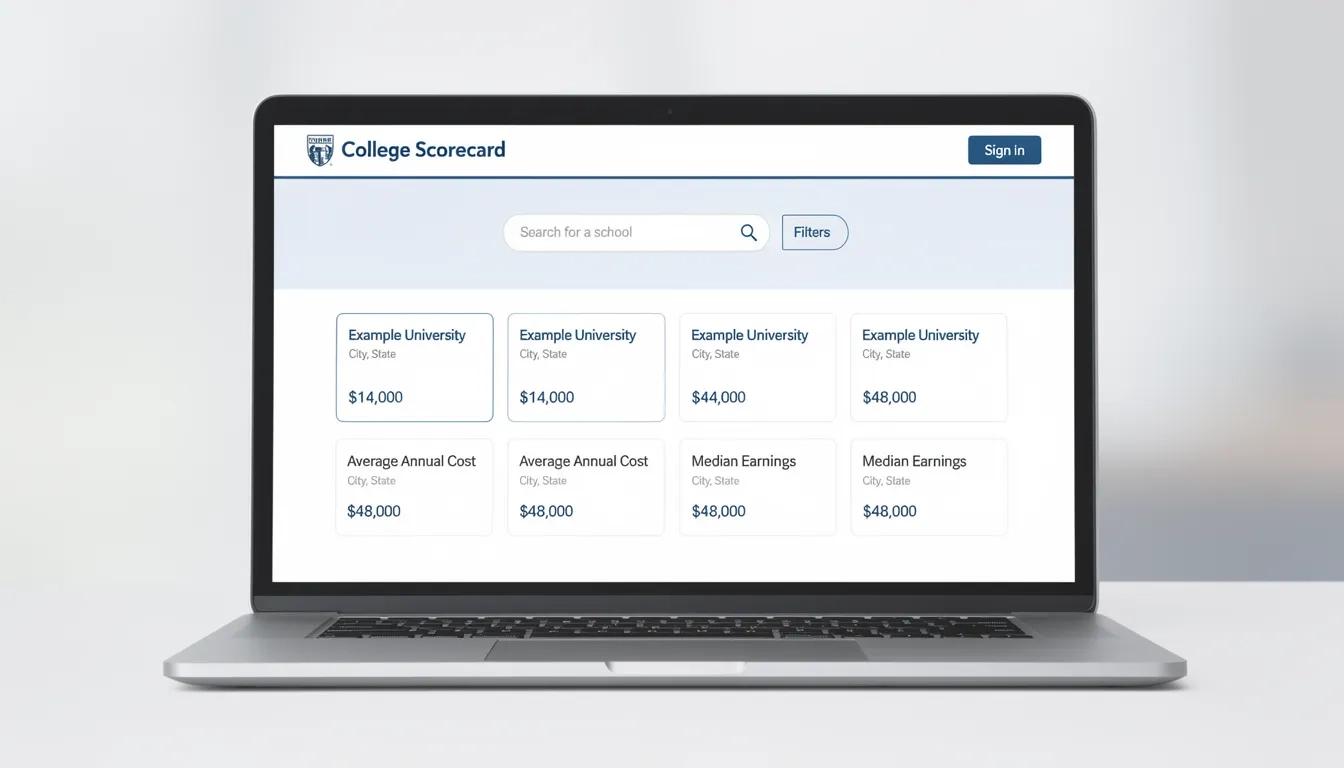
Walk into any college fair and you'll hear the same question, a thousand different ways: "Which school is worth it?" The College Scorecard, a free tool from the U.S. Department of Education covering more than 7,000 institutions, was built to help answer that. Most families who find it spend four minutes clicking around, get overwhelmed, and close the tab. That's a real mistake.
What the College Scorecard Actually Is
The Scorecard launched in 2015 under the Obama administration as part of a broader push for transparency in higher education pricing. The mechanics are clever: the government links federal aid disbursements to IRS earnings records, which means they can report, with actual data, what nursing graduates from a specific institution earn ten years after enrolling.
It now holds nearly 2,000 data points per institution. You can filter by location, school type, size, and offered programs. The compare tool lets you stack up to ten schools side by side in a shareable chart (you can email a link to your comparison, which is genuinely useful when getting a second opinion from a counselor or a parent).
But "data" and "useful data" aren't the same thing. The Scorecard's breadth can actually obscure the small number of figures that should drive your decisions.
The Three Numbers That Do the Most Work
Most families land on the sticker price first. Wrong number. The net price by income bracket is what actually matters.
The Scorecard breaks annual costs into five family income tiers: under $30K, $30-48K, $48-75K, $75-110K, and over $110K. A school with a $72,000 list price might show an average net cost of $14,300 for a family earning $45,000. The sticker price was never real for that family.
Graduation rates are a better quality proxy than most published rankings provide. A school graduating only 44% of students within six years is telling you something important about institutional investment in student success, regardless of how attractive the campus looks on a visit. A high graduation rate at a school with large Pell Grant enrollment signals something genuinely difficult done right.
Median earnings at six and ten years post-enrollment let you stress-test a potential debt load. If median earnings are $42,000 and median debt is $27,000, the numbers hold together. If median debt hits $58,000 against $38,000 in earnings, that's not just tight math; it's a portrait of financial difficulty for a lot of that school's graduates.
The Scorecard also tracks loan repayment at one, three, five, and seven years post-enrollment. Whether borrowers are actually paying down balances, rather than watching them grow, tells you something real about how financially equipped graduates are when they leave.
The Field-of-Study Feature Most People Skip
Here's what almost nobody tells high school seniors: the earnings gap between majors at the same school is far larger than the earnings gap between schools. Brookings Institution researchers found that at a single university, electrical engineering graduates earn around $108,000 annually while child and family studies graduates earn roughly $39,600. Same campus, $68,400 difference per year.
Program-level data lives under the "Academics" tab on each school's Scorecard profile. You can pull median earnings and median debt for a specific major across every institution that reports it.
This changes what comparison even means. A student planning to study social work at a flagship research university isn't competing in the job market with that school's software engineers. Using blended institutional medians to compare schools, when you already know your intended major, is comparing the wrong things entirely.
Here's how to use the field-of-study filter:
- Go to collegescorecard.ed.gov and search your target school
- Click into "Academics" and select your intended field
- Record the median earnings and median debt for that specific program
- Run the same lookup for every school on your comparison list
For technical programs at broad universities, the institutional median almost always understates what those specific graduates earn. For education and fine arts programs, the reverse tends to be true.
The Limitations You Need to Know
The Scorecard's most significant structural flaw is openly acknowledged: earnings data only covers students who received federal financial aid. Brookings estimates this represents about 51% of U.S. undergraduates nationally.
That gap creates systematic distortion. Students without Pell grants or federal loans tend to come from higher-income families and tend to earn more post-graduation. At Stony Brook University, for example, roughly 30% of undergraduates don't appear in the earnings data at all. The published median almost certainly understates actual outcomes for that institution.
There's also a technical quirk that affects what "earnings" even means in this context: every student who ever enrolled, including those who transferred out after one semester or never completed a degree, gets counted in the institution's earnings figures. Read the fine print. A school known as a transfer launchpad to stronger universities gets credit for earnings those students built at their final destination.
Data lag is real. Most figures run two to four years behind when you're reading them, and earnings data can reflect students who started college a full decade ago. A school that transformed its career placement operation in 2022 looks identical in the Scorecard to its version from 2016.
The Scorecard tells you what graduates earn. It does not tell you why.
That distinction matters enormously when comparing schools with very different student demographics. A school admitting students with exceptional academic records and family networks may show high median earnings because of who it recruits, not because of what it does for them.
Building a Comparison That Actually Holds Together
The compare feature is where the Scorecard becomes genuinely useful as a decision instrument. Here's the process that works:
Step 1: Net price first, everything else second. Remove any school from your list where the net cost at your income bracket makes the required borrowing unsustainable. No amount of brand reputation changes what the math says.
Step 2: Switch to field-of-study data before drawing earnings conclusions. If you know your intended major, institutional averages tell you almost nothing useful.
Step 3: Run a debt-to-earnings ratio. Divide median program debt by median annual earnings for that specific field. Below 1.0 is healthy. Above 1.5 deserves scrutiny. Above 2.0 is a warning flag for that program at that school.
Step 4: Read graduation rates in context. A 60% six-year rate at an open-enrollment community college with a working-class student body is a fundamentally different story than 60% at a residential four-year university with strong applicants and low financial barriers.
Here's how those factors compare across four school profiles reflecting patterns common in actual Scorecard data:
| School Type | Net Price (Mid-Income) | Grad Rate | Median Earnings (10yr) | Median Debt |
|---|---|---|---|---|
| State Flagship | $14,200/yr | 74% | $52,000 | $22,500 |
| Private Liberal Arts | $21,800/yr | 84% | $49,000 | $27,900 |
| Regional Public | $9,100/yr | 58% | $44,000 | $19,300 |
| For-Profit | $18,600/yr | 41% | $37,000 | $34,100 |
The for-profit row isn't invented. This profile, high cost relative to outcomes, poor completion, heavy debt load, is exactly the pattern the Scorecard was built to expose. For-profit chains like Corinthian Colleges faced federal accountability actions partly because aggregate data made their outcomes impossible for regulators to ignore at scale.
Where the Scorecard Beats Rankings (and Where It Doesn't)
U.S. News rankings drop every fall and cause a predictable scramble. Those rankings weight peer reputation surveys, selectivity, and alumni giving rates. None of that tells you whether a student at your income level, pursuing your specific major, will be financially stable after graduating.
My honest view: for most families, the Scorecard is a more useful instrument than any published ranking. Rankings tell you how universities are perceived by other university administrators. The Scorecard tells you what graduates actually earn and owe. For a family deciding whether to take on $80,000 in debt, those are fundamentally different questions.
That said, Scorecard data can't measure fit. Earnings figures don't capture whether you'll find mentors, build community, or thrive academically in a specific environment. A student who chooses purely on debt math and spends four years miserable hasn't made a good decision, just a defensible one on paper.
The right frame: use the Scorecard to screen out schools that fail a basic affordability and outcomes test. Then use everything else, campus visits, conversations with current students, program-specific signals, to choose among the ones that pass.
Georgetown's Center on Education and the Workforce publishes annual ROI rankings that build directly on Scorecard data and add 40-year earnings projections adjusted for debt costs. For a longer financial horizon on the college decision, their reports are worth reading alongside your Scorecard research.
Bottom Line
The College Scorecard is genuinely powerful when you use the right variables. Here's what to actually do:
- Start with net price at your income bracket, not the list price. One number is real; the other is marketing.
- Switch to field-of-study data before comparing earnings across schools. Major-level differences dwarf school-level differences in post-graduation pay.
- Run a debt-to-earnings ratio for each program you're seriously considering. The closer to 1.0, the more financial breathing room graduates typically have.
- Treat graduation rates as a quality signal. Low completion rates are almost always a warning, regardless of institutional prestige.
- Use the Scorecard to eliminate clearly bad options. Use everything else to choose among the good ones.
The single most important insight the data keeps surfacing: where you go matters less than what you study, and what you'll owe matters more than either.
Frequently Asked Questions
Is the College Scorecard data accurate?
For the students it covers, the earnings data aligns reasonably well with other federal sources. Brookings found that the Scorecard's median earnings estimate of $46,200 tracked closely with Census Bureau figures of $49,500 for comparable demographics. The bigger concern isn't measurement error; it's that only about 51% of students are represented in the earnings figures at all, which creates systematic gaps for schools with fewer federal aid recipients.
How do I find earnings by major on the College Scorecard?
Search for a school on collegescorecard.ed.gov, then scroll to the "Academics" section. Select a specific field of study and the Scorecard will show median earnings and median debt for graduates of that program. Not every program has data (small programs sometimes don't have enough students for reliable figures), but most common majors at larger institutions will show results.
Does the College Scorecard include graduate programs?
Historically, the Scorecard has covered undergraduate programs only. Expansion to graduate-level data has been discussed by Department of Education officials, given that graduate students borrow substantially more per year than undergraduates, but formal implementation timelines have not been announced as of this writing.
Why does the Scorecard sometimes show no earnings data for a school?
Some institutions primarily serve students who don't receive federal financial aid, which means there's no linked IRS earnings data to report. Small schools, highly selective private colleges where many students pay without federal aid, and some specialized institutions fall into this category. Absence of data doesn't mean graduates earn poorly; it means the federal tracking mechanism simply doesn't apply to enough of that school's students.
Myth vs. Reality: Does a higher-ranked school always mean better Scorecard outcomes?
Not even close. Scorecard data regularly shows regional public universities and state flagships outperforming nationally recognized private institutions on net cost and debt-to-earnings ratios. The variable that matters most is your specific major and your family's income bracket. A nursing program at a regional public can show substantially better financial outcomes than the same major at a prestigious private school once actual net cost enters the calculation.
What should I compare if the Scorecard shows similar numbers for two schools?
Dig into program-specific data rather than institutional averages, and look at the loan repayment rate progression, not just whether borrowers carry debt, but whether they're actively reducing it over time. Also check the Pell Grant percentage as an indicator of economic diversity and institutional support infrastructure. For qualitative factors the Scorecard doesn't capture, the Common Data Set published annually by each institution is the closest thing to a verified factbook you'll find outside of federal data.
Sources
- College Scorecard | U.S. Department of Education
- Deconstructing and Reconstructing the College Scorecard – Brookings Institution
- Understanding the College Scorecard – Brookings Institution
- Making Sense of the College Scorecard – College Kickstart
- Change Is on the Way for the College Scorecard – The Hechinger Report
- Ranking 4,600 Colleges by ROI (2025) – Georgetown Center on Education and the Workforce