Jack Kent Cooke Foundation Scholarship: A Complete 2026 Guide
The Jack Kent Cooke Foundation has given away more than $285 million in scholarships since 2000. That number matters because this isn't a feel-good $500 prize — we're talking up to $55,000 per year, per student, last-dollar funding designed to make an elite education genuinely affordable for families who couldn't otherwise access it.
Jack Kent Cooke himself was a Canadian-born businessman who built a fortune in cable television and real estate (and owned both the Los Angeles Lakers and the Washington Redskins) without ever earning a college degree. The foundation bearing his name rests on a clear premise: your financial circumstances shouldn't determine your educational ceiling. Three programs now execute that idea across different life stages, from middle school through community college.
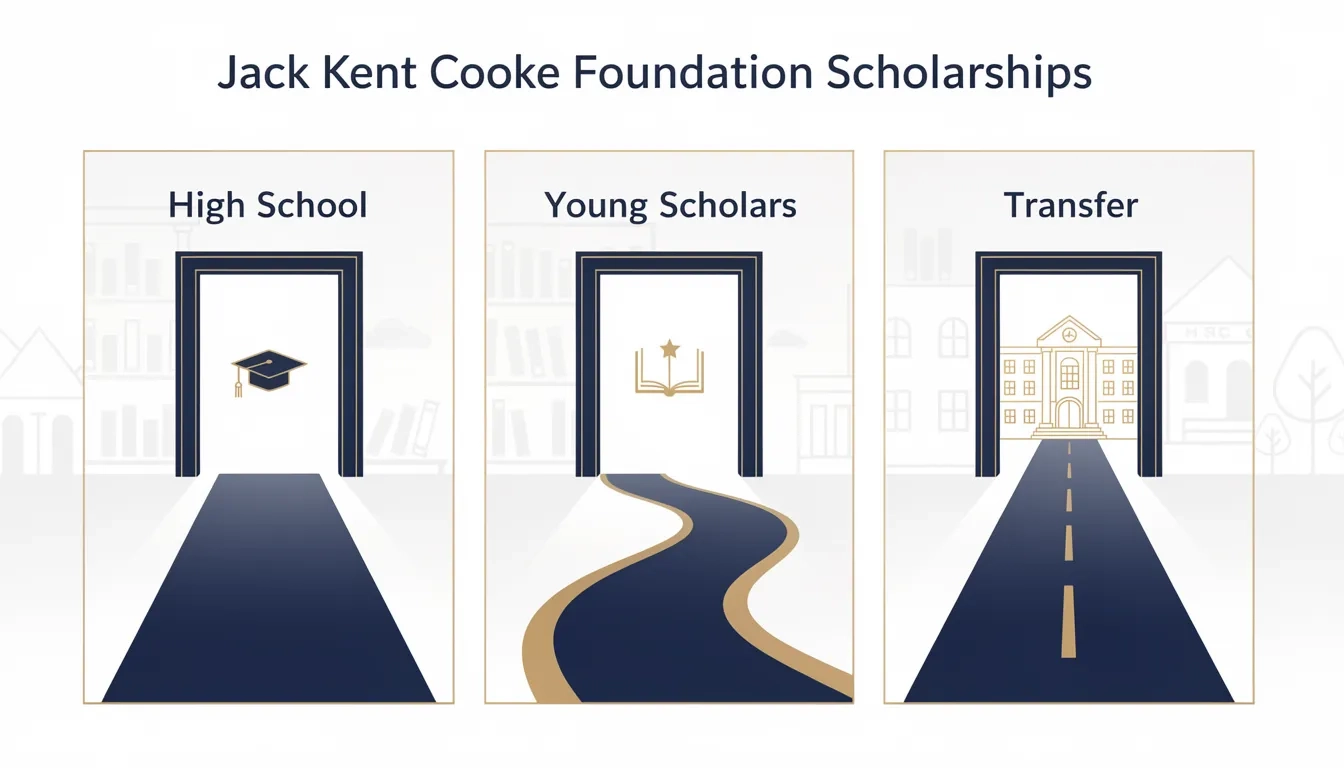
Three Programs, Three Entry Points
The Foundation runs three distinct scholarships. They share an income ceiling but differ significantly in who they serve, what they require, and when you need to apply.
| Program | Applicant Type | Application Closes | Annual Award | Recipients/Year |
|---|---|---|---|---|
| Young Scholars Program | 7th graders entering 8th | Spring | Support through HS | ~65 |
| College Scholarship | High school seniors | November | Up to $55,000 | ~40–50 |
| Undergraduate Transfer | Community college students | January | Up to $55,000 | ~60 |
Family adjusted gross income up to $95,000 is the threshold across all three. But technically qualifying and being a competitive applicant are two different things. The median family income for recent College Scholarship recipients was approximately $34,000 — well below the stated ceiling. Financial need isn't just checked; it's weighed.
All three programs evaluate the same four qualities: academic achievement, financial need, persistence, and leadership. How those qualities show up in applications, though, varies considerably by program.
The College Scholarship Program: The Flagship
High school seniors apply through the Common Application — the Foundation is listed as a "school" — during a narrow fall window. The 2027 cycle opens August 19, 2026 and closes November 11, 2026. Missing that deadline means waiting a full year.
Academic floor: unweighted GPA of 3.75 minimum, though admitted scholars averaged 3.98 in recent cohorts. You also need at least one standardized test score on file — SAT, ACT, any AP exam, or any IB exam. There's no stated minimum score. The Foundation wants proof you've been tested, not proof you scored perfectly.
What a complete application includes:
- Two academic recommendations through Common App (one must be from an 11th-grade teacher in a core subject: English, math, science, social studies, or a foreign language)
- School counselor recommendation and official transcript
- Multiple short essays
- Three years of household Adjusted Gross Income documentation
- Self-reported test scores and extracurricular activity list
The scholarship covers tuition, room and board, books, and required fees. Because it's last-dollar funding, institutional grants are applied first and Cooke fills what remains up to the annual cap.
Recent scholar data sets a real benchmark: 93% of admitted College Scholarship recipients held leadership positions in extracurricular activities, and 89% participated in civic or community service during high school. These aren't soft extras — they're the profile of who actually gets selected.
One policy note for 2027 applicants: the Foundation expects essays to be "wholly your own" and asks that any generative AI use be disclosed. Reviewers are explicitly trying to understand who the applicant is. An essay that sounds polished but hollow is a liability, not a credential.
The Young Scholars Program: Getting In Early
Most scholarship guides bury this program. That's a mistake, and it might be the best-kept secret in K–12 scholarship funding.
Students apply during 7th grade for entry in 8th grade. In 2025, 65 new scholars were selected nationally. The support runs all the way through high school graduation: summer residential programs on college campuses, personal educational advising, technology and subject-specific assistance, and career exploration resources.
Eligibility requirements:
- Grades of all or mostly As, with no Cs or lower in core subjects since 6th grade
- Family AGI at or below $95,000 (median admitted household income was ~$49,000)
- Current 7th grade enrollment in the U.S. or a U.S. territory
The practical advantage here isn't just the support itself — it's the timing. Students who enter Young Scholars arrive at high school with advising infrastructure that most peers don't access until junior year. They choose courses, plan extracurriculars, and prepare with context that changes outcomes.
Young Scholars who later apply to the College Scholarship Program aren't automatically admitted, but they arrive at that application far better positioned than most.
The Undergraduate Transfer Scholarship
Community college students are among the most financially precarious in American higher education — and also among the most overlooked by large scholarship programs. Cooke is a meaningful exception.
The Transfer Scholarship serves students with at least sophomore standing at a two-year institution who plan to finish a bachelor's degree at a four-year school. The 2026 cycle drew over 1,300 applications and selected 60 scholars, working through a semifinalist pool of 485 students. From full applicant pool to selected scholar: roughly a 4.6% rate.
Requirements:
- Cumulative undergraduate GPA of 3.50 or better (recent cohort averaged 3.92)
- Sophomore status at a community college by January 1 of the application year
- Family AGI at or below $95,000
- Intent to transfer to an accredited four-year institution
The award covers two to three years of study at up to $55,000 annually. Foundation CEO Giuseppe Basili described the 2026 class as reflecting "the depth of talent and determination found in community colleges across the country." That framing tells you exactly what reviewers were looking for: not students who had smooth paths, but students who built something real within difficult ones.
What Reviewers Actually Want to See
The four official criteria are academic achievement, financial need, persistence, and leadership. But two are consistently underweighted by applicants.
Academic achievement isn't just your GPA number. Reviewers evaluate course rigor relative to what was available at your school. A 3.98 from a school offering 25 AP courses reads differently than a 3.98 from a school with three. Intellectual curiosity matters too — do you pursue learning beyond class requirements? — and recommendation letters are where this impression gets made or missed.
Persistence is the differentiator. Most competitive applicants have strong grades and a list of activities. Fewer have a specific, honest account of a real obstacle they faced and what they actually did about it. The Foundation isn't looking for victimhood narratives — it's looking for agency. How you responded to difficulty, what you built or changed, how the experience shaped your direction. This criterion shows up in essays and recommendation letters more than anywhere else.
"The Foundation looks for students who have displayed academic excellence, leadership in their school and community, and persistence in the face of challenges or adversity."
Leadership gets misread as titles. Being vice president of a club you attended twice a year doesn't demonstrate what reviewers want. Concrete impact does: organizing a tutoring program that served 40 underclassmen, running a fundraiser that brought in $23,847 for a local food bank, launching a school newspaper that didn't exist before you arrived. The question reviewers are implicitly asking: did this person actually move others?
Application Strategy: Where the Work Goes
The two highest-leverage elements in any Cooke application are essays and recommendations. Most applicants don't treat them that way.
Get recommendations lined up in September, not October. One must come from an 11th-grade teacher in a core academic subject — that's a specific constraint you can't route around. Identify this person early, then brief them: share your résumé, draft essays, and two or three specific stories you'd like them to address. Teachers who receive a late-October request and no context produce letters that say "she works hard." Teachers who receive early outreach and real material produce letters that name something specific.
Essays are not a highlight reel. Reviewers have read thousands of achievement summaries. What they read less often is a specific, honest account of what an applicant actually had to work through — and what they chose to do about it. The persistence essay is where most applications succeed or fail. Don't write "I overcame adversity and emerged stronger." Write what the adversity actually was, what you specifically did, and what changed because of it.
Three patterns that show up in weak applications:
- Vague leadership claims — titles and memberships with no evidence of impact
- Essays that sound like everyone else — polished but generic, specific to no one
- Requesting recommendations in late October — rushed letters from well-meaning teachers who had no context
One strategic reality: the income ceiling is $95,000, but the median admitted student comes from a family earning closer to $34,000–$49,000. If your household earns $88,000 and you meet the academic bar, apply — but understand where you sit relative to the typical cohort and make sure your financial narrative is accurate and well-documented.
Benefits Beyond the Annual Award
The scholarship pays for school. The advising network is what makes the Cooke experience genuinely unusual.
Every scholar receives a personal Foundation advisor for the duration of their undergraduate years. This advisor helps navigate financial aid packaging at specific schools, course selection, internship opportunities, and graduate school planning — the kind of guidance that normally requires a well-connected family or expensive private college counseling.
Beyond advising, scholars can apply for:
- Internship stipends (to make unpaid opportunities financially viable)
- Conference and travel grants
- Graduate scholarship funding through the Foundation's separate graduate program
The alumni community currently includes nearly 3,200 Cooke Scholars — small enough that the network is actually tight, large enough to have real professional reach across industries.
My honest take: the advising benefit is consistently undervalued in how applicants think about this scholarship. A well-advised Cooke Scholar applying to schools that meet 100% of demonstrated financial need can graduate from an institution like Williams College or Amherst carrying almost no debt. That outcome isn't guaranteed, but it's the goal the program is built to achieve.
Bottom Line
- Three programs serve different stages: Young Scholars (7th grade entry), College Scholarship (high school seniors, deadline November), Transfer Scholarship (community college, deadline January) — know which applies and when
- The $95,000 income ceiling is the floor, not the center; median admitted students earn significantly less, and financial need is genuinely weighted
- Essays and recommendations determine outcomes — start both in September, give recommenders real context, and write essays that are specific to you and no one else
- Persistence is the most differentiated criterion and the one most consistently undersold by applicants
- The personal advising program and graduate scholarship access make the total value of Cooke far larger than any single year's award
Frequently Asked Questions
What GPA is actually required for the Jack Kent Cooke College Scholarship?
The stated minimum is a 3.75 unweighted GPA. In practice, recent admitted cohorts averaged 3.98 unweighted. You should also be taking the most rigorous coursework available at your school — reviewers consider rigor relative to what your school offers, not an absolute national standard.
Is the Cooke scholarship renewable every year?
Yes, with conditions. College Scholarship recipients must maintain a minimum 3.0 GPA, demonstrate continued financial eligibility, stay engaged in community and leadership activities, and attend mandatory Foundation programming. The Foundation conducts annual reviews. Losing the scholarship mid-college is possible but uncommon among students who engage with the advising program.
Can undocumented students or non-U.S. citizens apply?
U.S. citizenship is not required. Applicants must reside in the United States, a U.S. territory, or on a U.S. military base during their final year of high school. Students with DACA status or other non-citizen documentation may apply if they meet residency and academic requirements. GED recipients are not eligible for the College Scholarship Program.
Does winning the Cooke scholarship reduce my other financial aid?
Because Cooke functions as last-dollar funding — applied after institutional grants and aid — it generally layers on top of what a school already offers rather than replacing it. That said, individual schools handle outside scholarship notification differently. Ask the financial aid office at schools you're seriously considering how they treat outside awards before you commit anywhere.
What do the essay prompts look like?
The Foundation doesn't release specific prompts before the application opens. Based on the application structure, essays cover academic interests, personal background, obstacles faced, community involvement, and future goals. The prompts shift slightly year to year, which is one more reason not to wait until late October to start writing.
Is applying to the Young Scholars Program worth it if a student also plans to apply to the College Scholarship later?
Yes, and strongly. The programs are separate — Young Scholar status doesn't guarantee College Scholarship admission. But students who complete the Young Scholars Program arrive at senior year with years of advising, stronger course selection, and better-developed extracurricular records. The preparation advantage is real and measurable.
Sources
- College Scholarship Program - Jack Kent Cooke Foundation
- FAQs - Jack Kent Cooke Foundation College Scholarship Program
- Undergraduate Transfer Scholarship - Jack Kent Cooke Foundation
- Young Scholars Program FAQs - Jack Kent Cooke Foundation
- Jack Kent Cooke Foundation Announces 2026 Undergraduate Transfer Scholarship Recipients