How to Transition from Military to Civilian Career
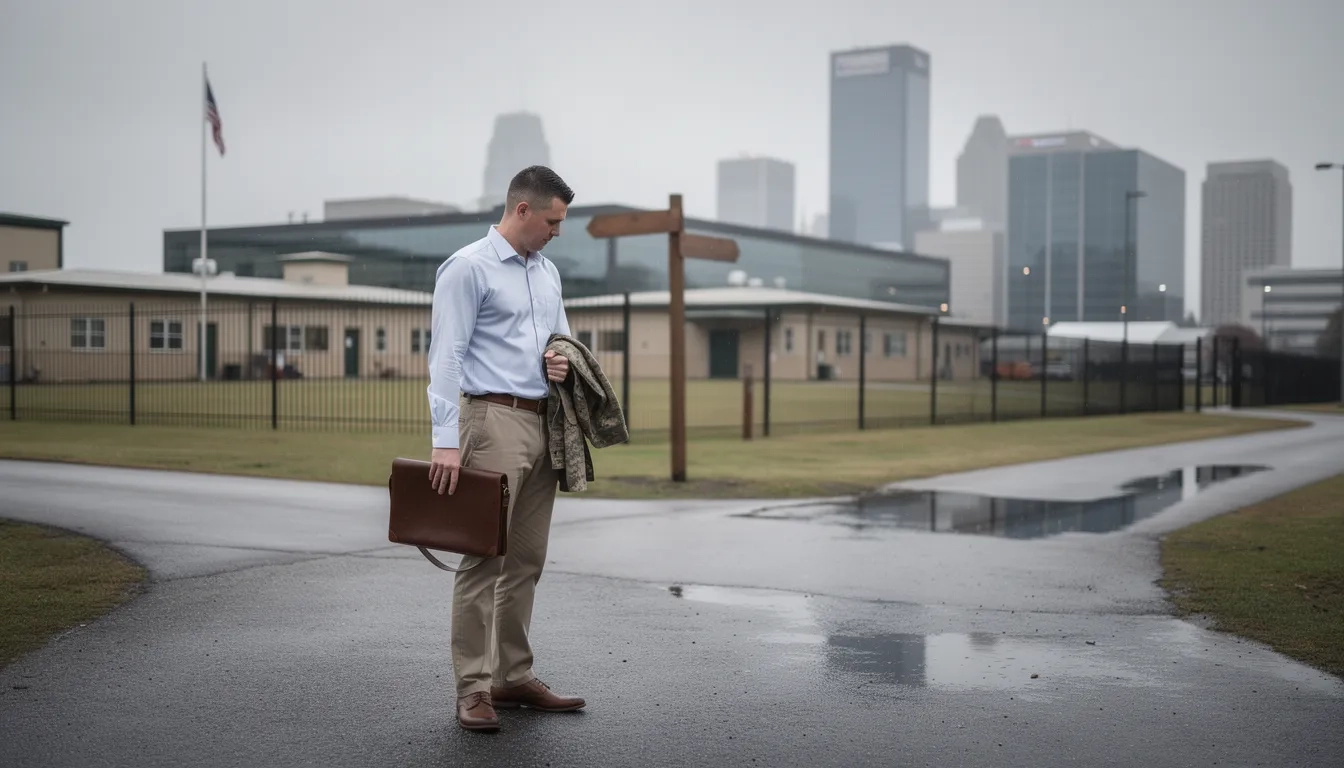
About 200,000 service members separate from active duty every year. Most have led teams under pressure, managed millions of dollars in equipment, and operated in environments where failure cost lives. By almost any professional standard, these are exceptional candidates. Yet research from AARP's veteran employment programs shows that roughly one-third of veterans end up underemployed — working in roles that don't match their actual skills or education. They're also 16% more likely than civilian workers to be in those mismatched roles.
This isn't a talent problem. It's a translation problem. And it's solvable.
Why the Transition Is Harder Than It Looks
Two-thirds of transitioning service members report significant difficulty adapting to civilian work life. That number is striking, given how capable most of these people demonstrably are.
Part of the problem is structural. The military doesn't use resumes. After years — sometimes decades — of promotions and performance reviews written in military-specific formats, most service members have never once needed to condense their experience into two pages of plain English. That feels minor until you're 60 days from separation, staring at a blank document, trying to explain what an E-7 actually does in terms a civilian HR director will understand.
The deeper issue is cultural. Military culture prizes collective achievement. "We accomplished the mission" is the natural way to describe success. Civilian hiring, though, is almost entirely focused on individual contribution. What did you specifically do? What was the outcome? How can you prove it? That mental shift doesn't happen automatically.
There's also the identity piece, which rarely gets discussed. For many veterans, rank and role are identity. When you leave, both go with you. The psychological adjustment of figuring out who you are when you're no longer Staff Sergeant or Lieutenant Commander can quietly derail a job search that looks fine on paper.
Start Earlier Than You Think You Need To
The Department of Defense mandates transition assistance through SFL-TAP (Soldier for Life-Transition Assistance Program), and the requirement is strict: begin no later than 365 days before your separation date.
But "mandatory start" and "optimal start" are two different things. Veterans who transition smoothly — who land jobs at or above their skill level within 60 to 90 days of separation — typically start 18 months out. Here's why the extra runway matters:
- SkillBridge eligibility requires at least 180 days of service remaining. Wait until the 365-day window and you've already missed your shot at working full-time for a civilian employer while still drawing military pay and benefits.
- Networking takes longer than job applications. The research consistently shows that referrals and personal connections drive a large share of successful veteran placements. Building those relationships takes months, not weeks.
- Federal hiring moves slowly. A USAJobs.gov posting can close in five days but take five months to produce a tentative offer. If you're using veterans' preference, you need lead time.
Here's a practical planning framework:
| Timeframe Before Separation | Key Actions |
|---|---|
| 18–24 months | Assess skills, identify target industries, begin building LinkedIn |
| 12–18 months | Start SFL-TAP counseling, research MOS-to-civilian crosswalks |
| 6–12 months | Apply to SkillBridge or Career Skills Programs |
| 3–6 months | Active job applications, interview prep, salary benchmarking |
| 30–90 days | Finalize benefits enrollment, complete all TAP requirements |
Retirement-eligible personnel can start SFL-TAP counseling up to 24 months before their retirement date. Use it.
The Language Barrier: Translating Military Skills
This is where most veterans lose ground they shouldn't. The skills are real. The resume just doesn't prove it to a hiring manager who has never heard of an NCOIC or has no idea what an "E-5 team leader, 11B Infantry" actually involved day-to-day.
The fix is translation, not reinvention. You're not pretending to be someone you're not. You're explaining what you actually did in language the audience can understand.
A few concrete examples of how this works in practice:
- "Tank crewmember, 1st Armored Division" becomes "Heavy equipment operator; led a 4-person crew responsible for a 68-ton vehicle, managed maintenance schedules and operational readiness"
- "Supply Sergeant, 82nd Airborne" becomes "Logistics Manager; oversaw $2.3 million in unit equipment with 99.7% accountability across two overseas deployments"
- "First Sergeant" becomes "Senior Personnel Manager; directed HR functions for a 180-person organization including performance evaluation, disciplinary processes, and professional development"
Philip Lapple, a former Army tanker who has advised veterans on career transitions, has described this process well: the job isn't just swapping titles, it's surfacing the skills buried inside the military description. "Mentoring, efficiency, and workload planning" — those phrases resonate with civilian recruiters, even if the context was a tank platoon in Germany.
Two tools worth knowing:
- O*NET OnLine's Military Crosswalk — enter your MOS, rate, or AFSC and it maps your role to civilian occupation codes with detailed skill overlap data
- My Next Move for Veterans (mynextmove.org) — simpler interface, same crosswalk data, designed for self-guided use
Numbers close the gap. Civilian managers respond to metrics. Budget managed, personnel supervised, training completion rates, inspection results — whatever you can quantify, put it in. "Managed equipment valued at $4.7 million with zero loss over 36 months" is a different sentence than "responsible for unit equipment."
SkillBridge: The Best Program Most Veterans Underuse
The DoD SkillBridge program is one of the best-designed transition tools available, and too many service members find out about it too late.
Here's how it works: during your final 180 days of service, you work full-time for a civilian employer — an internship, apprenticeship, or on-the-job training slot. You keep your full military pay and benefits. The employer pays nothing for your labor. At the end, many extend job offers.
The numbers are hard to argue with. Hiring Our Heroes, one of the major SkillBridge intermediaries, tracks an 80% program-wide hire rate, with fellows starting at average salaries of $70,000. Participants reach stable employment within one month at nearly double the rate of veterans without structured support: 63% versus 38%. As of fiscal year 2025, roughly 25,000 service members were enrolled across more than 6,300 partner organizations, including Northrop Grumman, Amazon, and hundreds of smaller employers.
The real advantage isn't just the work experience. It's that you're essentially interviewing for 90 days straight, in a real job, with low enough stakes to actually show who you are.
The catch: you need commander approval, and the organization must be on the approved SkillBridge list. Apply at least six months in advance. Some commanders are skeptical, but framing it as professional development that reflects well on the unit tends to move the conversation forward.
If your target employer isn't on the approved list, ask them to apply. The process for employers is straightforward. Many companies don't know the program exists until a candidate tells them.
Networking: The Part Nobody Wants to Do
Here's an uncomfortable truth about the veteran community: it's extraordinarily tight-knit and generous, and most transitioning service members don't take nearly enough advantage of it.
LinkedIn is not optional. The platform is the primary channel through which recruiters find candidates for mid-to-senior roles. A complete profile with translated job titles and a clear skills summary will generate inbound messages. A profile that reads like an Officer Evaluation Report won't.
American Corporate Partners (ACP) runs one of the better free mentorship programs for veterans — it matches you with a business executive for a year-long mentorship engagement. Their data shows veterans with mentors find jobs 47% faster than those going it alone. The program pairs about 3,000 veterans annually.
A few networking moves that actually work:
- Search LinkedIn for alumni of your unit, base, or installation. People who've already made the transition are usually willing to do a 30-minute call. They know exactly where you're standing.
- Attend industry events, not just veteran events. You want to be in rooms with people who work in your target field, not exclusively other veterans.
- Be specific about what you're asking for. "I'm looking for a 20-minute informational call about supply chain roles in the medical device industry" is a request people can say yes to. "I'm looking for a job" is not.
Post-Veterati focuses on executive and senior-level placements. NextOp Veterans specifically serves junior enlisted personnel (E1–E6) who often face the steepest translation challenges.
The Federal Government Track
Federal employment deserves its own section because the advantage is real and specific.
Veterans' preference gives qualifying veterans added points in the USAJobs.gov hiring process: 5 points for honorable service, 10 points for a service-connected disability. For competitive positions, preference factors into how candidates are ranked. It's a meaningful edge in a system where hiring decisions routinely come down to fractional score differences.
The Schedule A hiring authority (for veterans with disabilities rated 30% or higher) and the Veterans' Employment Opportunity Act (VEOA) both allow veterans to compete for federal roles that would otherwise be closed to outside candidates. These are underused tools.
About 30% of federal civilian employees are veterans. Agencies like the VA, DoD, DHS, and FBI actively recruit from transitioning service members. The salaries start lower than private sector equivalents for comparable roles, but the total compensation — benefits, stability, pension options — often closes that gap. For veterans carrying an active security clearance, the math shifts further: cleared positions at defense contractors and federal agencies carry real salary premiums.
One practical note: federal job applications require patience. A posting might close within five days, but an offer can take four to six months. Keep a tracking spreadsheet. Don't stake your entire job search on one federal application.
Bottom Line
My honest take: the veterans who struggle most in this transition aren't the least qualified — they're the ones who underestimated the timeline and assumed their resume would speak for itself. It won't. Not without translation.
Start 18 months out, not 12. Use SkillBridge if you possibly can. Quantify everything on your resume before submitting a single application. Build your network before you need it. And take the LinkedIn profile seriously, even if it feels awkward.
The skills aren't the issue. The packaging is.
- Start SFL-TAP at 365 days minimum, 18 months ideally — earlier start keeps all options open, including SkillBridge
- Use O*NET's Military Crosswalk and My Next Move for Veterans to map your MOS to civilian occupation codes
- Quantify every accomplishment — equipment value, headcount, budget, completion rates
- Apply to SkillBridge six months out — 80% of Hiring Our Heroes fellows get hired by the host employer
- Complete your LinkedIn profile now — one strong profile beats 50 cold applications
Frequently Asked Questions
Does military experience count as real work experience for civilian jobs?
Yes, fully. Military service is treated as professional work history by civilian employers. The challenge is articulation, not legitimacy. Translate military titles and jargon into civilian equivalents, quantify your responsibilities with specific numbers, and lead with skills that map to the role you're targeting.
How long does the transition to a civilian job typically take?
Most veterans find their first civilian job within three to six months of separation, but outcomes vary significantly depending on industry, location, rank, and how early they began preparing. Veterans who use structured programs like Hiring Our Heroes reach stable employment within one month at roughly twice the rate of those navigating the process on their own.
Is it a myth that employers are reluctant to hire veterans?
Largely yes. Most large employers actively seek out veterans for leadership ability, discipline, and composure under pressure. The real barrier is usually that veterans don't translate their experience clearly enough for civilian hiring managers — not that employers are skeptical. That said, some organizations do carry misconceptions about PTSD or difficulty adapting to less hierarchical workplaces. Organizations like Hire Heroes USA coach veterans on addressing these topics directly in interviews rather than hoping the topic won't come up.
What civilian careers work best for combat veterans like infantry or 11B?
This is one of the harder translations because combat roles don't map cleanly to civilian job titles the way logistics or medical roles do. The paths that tend to work best: law enforcement, federal law enforcement agencies (FBI, DEA, CBP), emergency management, private security consulting, and project management (especially for veterans who earn a PMP certification after separation). The leadership experience from NCO and officer positions transfers directly — the key is getting that story onto paper in a way a civilian hiring manager can read and act on.
Should I use veterans' preference when applying for federal jobs?
Absolutely. Veterans' preference isn't charity — it's a formal recognition that your service imposed real opportunity costs on your career. Use every legal advantage available to you. If you have a service-connected disability rated at 30% or higher, look into the Schedule A hiring authority, which allows you to apply to federal roles not open to the general public. This is one of the most underused tools in the entire transition process.
How do I handle a long gap in my resume after leaving the military?
Be direct and brief about it. A simple explanation — "I served 12 years in the Army and have been exploring civilian career options since separation" — is enough. Employers are far more bothered by gaps with no explanation than by gaps that come with a clear, honest narrative. If you've done volunteer work, coursework, caregiving, or freelance work during that time, include it. Don't leave white space where context belongs.
Sources
- Employment Situation of Veterans – U.S. Bureau of Labor Statistics (2025)
- The Employment Situation of Veterans – D'Aniello Institute for Veterans and Military Families, Syracuse University
- SFL-TAP 2026: Military Transition Timeline & Checklist – Best Military Resume
- From Military to Civilian: Resume Translation – Military.com
- Military Experience to Civilian Career – AARP
- DoD SkillBridge Program – U.S. Department of Defense