Scholarship Stacking: How Awards Combine (And When They Don't)
Winning a $3,000 scholarship sounds like an unambiguous win. But at a surprising number of colleges, that check arrives and your institutional aid quietly drops by exactly $3,000. Net gain: zero. You spent months writing essays and gathering recommendations for a rounding error on your tuition bill.
This is scholarship displacement, and it's the part of college financial aid that nobody puts in the brochure.
The One Rule That Governs Everything
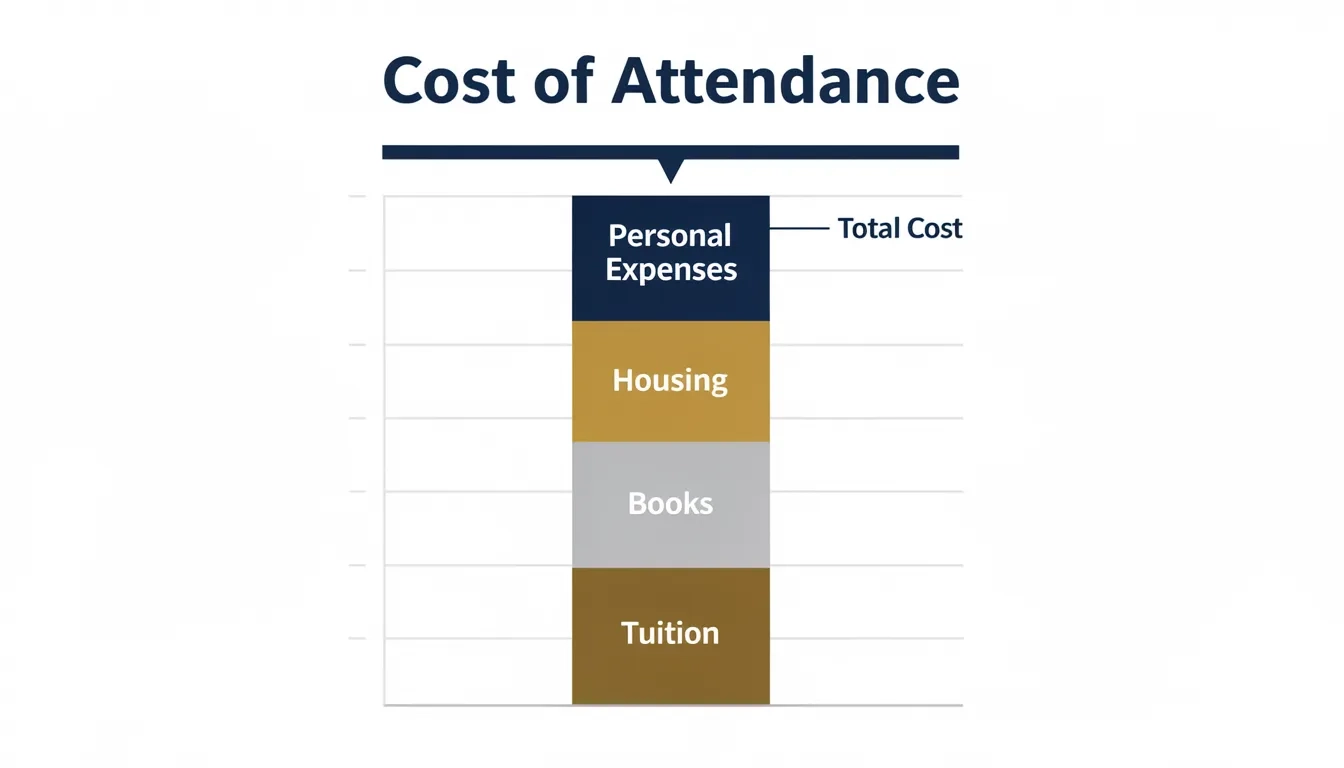
Before anything else, you need to understand Cost of Attendance (COA). It's the ceiling under which every dollar of aid you receive must fit—federal grants, institutional merit awards, athletic scholarships, outside private scholarships, all of it combined.
COA isn't just tuition. Schools calculate it to include tuition, fees, housing, food, books, transportation, and personal expenses. It varies by living situation—a school might set COA at $31,000 for commuters and $58,000 for students in campus housing.
Federal law prohibits total aid from exceeding COA. Schools aren't just being stingy when they reduce your award—they're responding to a hard legal limit, sometimes called the over-award rule.
Stacking vs. Displacement: The Core Distinction
"Scholarship stacking" means combining multiple aid sources—academic merit grants, need-based federal aid, athletic scholarships, and outside private awards—to drive down what your family actually pays.
Whether it truly adds up depends entirely on your school's policy.
Stacking means an outside award directly reduces your bill. You have a $32,000 institutional package; you win a $2,500 community foundation scholarship; your out-of-pocket drops by $2,500. Clean, fair, exactly what students expect.
Displacement means the school offsets your outside award by reducing its own grant. That $2,500 hits your account, the school's grant shrinks by $2,500, and your bill doesn't budge.
Displacement doesn't penalize students for bad planning. It penalizes them for doing exactly what every guidance counselor, financial aid workshop, and scholarship website tells them to do.
Research compiled by the College Confidential scholarship stacking forum found that roughly 20 percent of colleges reduce institutional grants when students earn outside awards. About half of students who receive private scholarships experience some form of displacement.
The Three Policy Types (And Why the Middle One Matters)
Schools rarely broadcast which camp they fall into. But there are really only three frameworks:
| Policy Type | What Happens | Net Impact |
|---|---|---|
| Full-Stack | Outside awards add directly to your package up to COA | Every dollar you earn reduces your bill |
| Partial-Stack | School reduces loans and work-study before touching grants | Real benefit—you borrow less, even if grants are protected |
| No-Stack | School reduces institutional grants dollar-for-dollar | Often zero net benefit; the displacement is complete |
The Partial-Stack category is worth pausing on. If your school reduces loans before grants, a $3,000 outside scholarship means you borrow $3,000 less. That's still valuable—debt you don't accumulate is money you don't repay with interest. But if the school goes straight for grants, you've won a scholarship competition for nothing.
Ask every school explicitly: "If I receive an outside scholarship, what gets reduced first—loans, work-study, or grants?" The answer tells you almost everything you need to know.
The Multi-Year Trap That Quietly Costs Thousands
Here's where stacking gets genuinely dangerous for families who don't ask the right questions upfront.
Suppose your school offers a renewable merit grant of $10,000 per year. You win a one-time $15,000 outside scholarship freshman year. Under a No-Stack policy, the school drops its institutional grant to nearly zero for that year.
The scholarship was one-time only. The grant reduction, as analysis from egelloC College Prep found, can be permanent.
Years two through four, the school recalculates your aid using the adjusted baseline. A $15,000 one-year outside award can cost $45,000 in cumulative lost institutional aid over four years. You won money. You lost more than twice as much.
This isn't an edge case. It's the predictable outcome when families don't investigate before reporting outside awards.
The practical fix is to call the financial aid office before reporting any outside scholarship and ask two direct questions: Does this reduce my existing grants? And if my package adjusts in year one, does that affect years two through four?
What's Actually Protected From Displacement
Not every type of aid is equally vulnerable, and knowing the distinctions is useful.
The Pell Grant is untouchable. Federal regulations prevent outside scholarships from reducing a student's Pell Grant. Families who qualify for Pell (the household income cutoff sits around $60,000 for maximum awards, though partial awards extend higher) are exempt from the displacement problem. Every outside dollar they earn genuinely stacks.
This creates a counterintuitive reality: a family earning $47,000 a year may benefit more from aggressive scholarship hunting than a family earning $130,000, because the lower-income student's core package survives the addition of outside awards intact. Middle-income families, paradoxically, bear the most displacement risk.
State grants sit in a gray zone. Some state programs protect themselves like the Pell does; others don't. Check with your state's higher education agency directly.
Subsidized federal loans are also worth mentioning. An outside scholarship that displaces loan eligibility is still a net positive—you're reducing debt you'd have had to repay anyway. The real pain comes when grants, not loans, get cut.
Athletic Scholarships: A Different Rulebook
College athletes operate under a separate framework, and that framework changed substantially after the House v. NCAA settlement was approved in June 2025.
Before the settlement, Division I coaches worked within fixed scholarship counts—a baseball program might have 11.7 scholarships to divide across a 35-player roster. Post-settlement, D-I schools now award athletic aid up to full COA with roster limits replacing scholarship caps entirely. That gives coaches more flexibility in how they package aid.
The stacking rules for athletes break down like this:
- Athletic scholarships can stack with academic merit grants and need-based institutional aid up to COA
- Under NCAA Bylaw 15.2.8.1.1, athletes who receive a Pell Grant may add it on top of a full athletic scholarship without violating NCAA rules
- Division III schools prohibit athletic scholarships entirely, but athletes can receive academic and need-based aid freely, with no athletic-money restrictions complicating the picture
A D-I swimmer might combine a $22,000 athletic scholarship, a $6,000 academic merit award, and a $3,800 need-based institutional grant—totaling $31,800 against a $35,000 COA. Perfectly legal, increasingly common.
What athletes should watch: outside scholarship policies apply to them too. Winning a local $2,000 scholarship as a recruited athlete could trigger a $2,000 reduction in the institutional grant component, not the protected athletic portion.
A Five-Step Process for Finding Out Where You Stand
Rather than guessing, run through this before you commit to any school:
- Search the financial aid website for "outside scholarships" or "scholarship stacking policy." About half of schools publish this clearly. If it's explicit, you can skip the call.
- Email the financial aid office with three questions: What gets reduced first when I report outside aid—loans, work-study, or grants? Does a year-one reduction affect my package in subsequent years? Is this policy in writing somewhere?
- Get the answer in writing. A verbal commitment from a counselor in October doesn't bind the office the following March when your award is rebuilt.
- Evaluate renewal terms before applying to any outside scholarship. A renewable $2,000-per-year local award may be worth more than a one-time $7,500 national award at a school with a No-Stack policy.
- Report everything. Schools require disclosure of outside aid under federal regulations. Failing to report isn't a workaround—it's financial aid fraud.
Strategies That Actually Work
The goal isn't to stop pursuing scholarships. It's to pursue them with clear eyes.
Target renewable awards. A $1,500 scholarship renewable for four years is worth $6,000. At a Partial-Stack school that reduces loans before grants, you'd borrow $6,000 less over your college career—with compounding interest savings on top of that.
Local scholarships offer better odds than national competitions. A regional foundation award with 40 applicants is a fundamentally different proposition than a national merit competition drawing tens of thousands of entries.
Factor stacking policy into your college list. Some families don't realize this is a choice point at all. Schools with Full-Stack policies are genuinely more valuable to students who plan to scholarship-hunt aggressively. Factoring policy into your list is at least as rational as comparing dining hall quality.
File your FAFSA regardless of income. Many families earning well above $100,000 skip FAFSA on the assumption they won't qualify for federal aid. But schools use FAFSA data to determine eligibility for institutional grants that have nothing to do with federal programs. Leaving it blank costs you information you can't get back.
Here's a position worth stating plainly: the No-Stack displacement model is bad policy. Schools benefit when students secure outside funding—it signals competitive, scholarship-worthy students and reduces institutional budget pressure. Penalizing that hustle with grant reductions actively works against the communities and foundations trying to help. Full-Stack schools understand this. No-Stack schools are keeping the financial aid system opaque to protect their own balance sheets.
Bottom Line
- Ask about stacking policy before anything else. Email financial aid offices on your list and get a written answer about what category gets reduced first when outside awards arrive.
- Prioritize renewable scholarships over one-time awards, especially at No-Stack schools. A $15,000 single-year award can cost far more in lost grants over four years than it ever delivers.
- Pell Grant recipients are in the best position. Outside scholarships stack on top of federal aid without displacement—every award genuinely reduces the bill.
- Athletes should ask separately how outside awards interact with both institutional and athletic aid components, particularly with post-House settlement structures still being implemented.
- The best time to investigate is before submitting applications, not after accepting an offer.
Frequently Asked Questions
Can you receive multiple scholarships at the same time?
Yes. There's no federal rule limiting the number of scholarships you can hold simultaneously. The only ceiling is your school's Cost of Attendance—total aid from all sources can't exceed it. Whether multiple awards actually reduce your bill depends on your school's stacking or displacement policy, not on any restriction on scholarship count.
Will winning an outside scholarship reduce my Pell Grant?
No. The Pell Grant is federally protected and cannot be displaced by outside awards. This is one of the few explicit student protections in the financial aid system—outside scholarships add on top of Pell eligibility, not instead of it. Pell recipients should scholarship-hunt without fear of triggering this particular trap.
What's the real difference between stacking and displacement?
Stacking means every award you win directly reduces what your family pays out of pocket. Displacement means an outside scholarship replaces part of the school's own grant—your bill stays identical, only the funding source changes. Most families don't discover which model their school uses until after they've already won an award.
Do I have to report private scholarships to my college?
Yes, always. Disclosure is required under federal financial aid regulations. Failing to report outside awards isn't a clever workaround—it can be treated as fraud. Understanding your school's stacking policy before you apply for outside awards is exactly how you protect yourself while staying compliant.
How do athletic scholarships interact with academic merit grants?
At most D-I and D-II programs, athletic aid can stack with academic merit grants and need-based institutional aid up to COA. NCAA Bylaw 15.2.8.1.1 specifically exempts Pell Grants from the athletic aid ceiling—an athlete on a full scholarship can receive a Pell on top. Division III prohibits athletic scholarships entirely, leaving athletes free to stack academic and need-based aid without any athletic-money complications.
Is it worth applying for scholarships if my school has a No-Stack policy?
Usually yes, but the math shifts. At schools that reduce loans before grants, outside awards still cut your debt load—and debt you don't accumulate is money you don't repay with interest. Renewable awards also matter more than one-time windfalls under No-Stack policies, since a permanent one-year base-grant reduction can cost far more than a single-year outside award delivers. Run the numbers before applying, not after winning.
Sources
- How to Stack Scholarships: Athletic, Academic, and Financial Aid Explained
- When Scholarships Don't Lower the Bill: A Student's Guide to Understanding Stacking and Displacement
- Outside Scholarships Explained: How Stacking Rules Affect Your Aid
- Mastering Scholarship Stacking: College Financial Aid Guide
- Scholarship Stacking Policies – Get the Facts Early
- Can NCAA Athletes Combine Athletic, Academic, and Pell Grants?