How to Get Research Funding as an Undergraduate
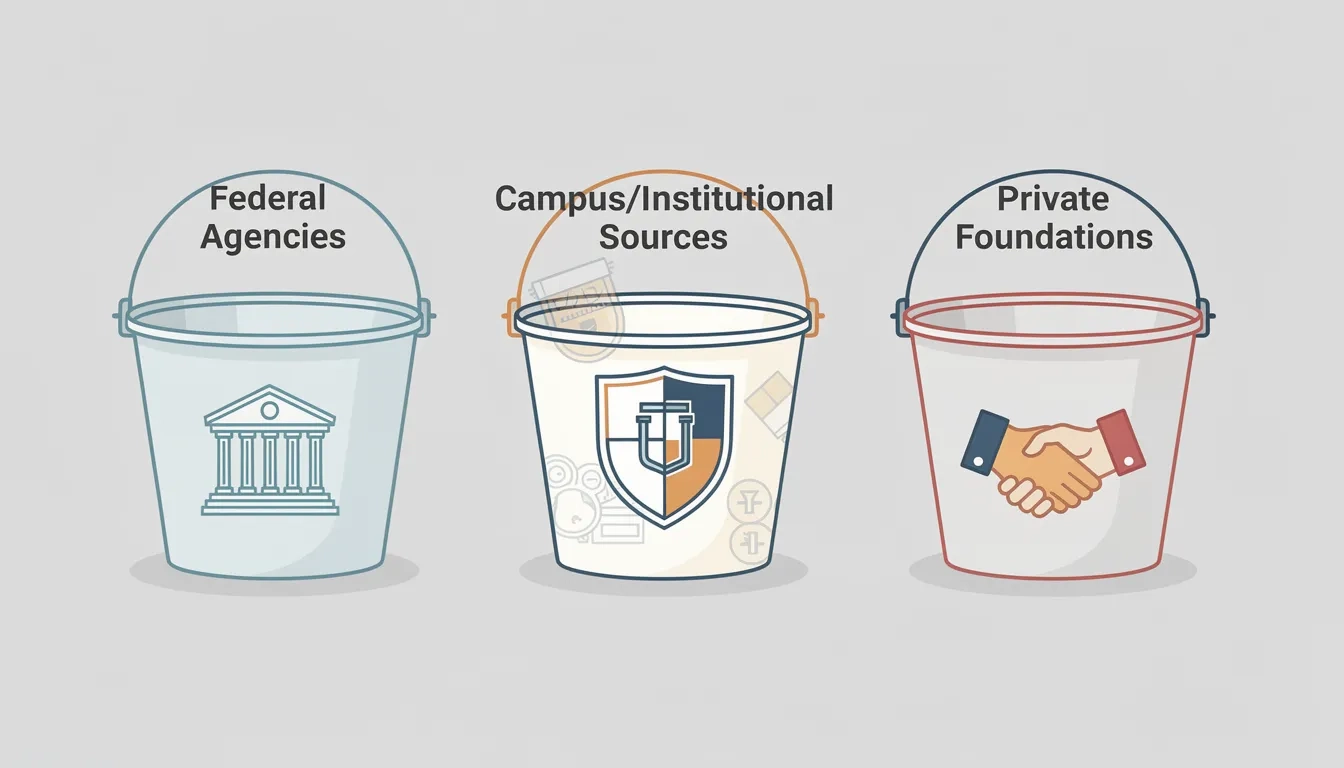
Most students who graduate without ever doing research weren't less qualified than the ones who did. They just never learned that the money was there in the first place. Undergraduate research funding sits across three distinct places — national programs, your own campus, and faculty budgets — and a surprising amount of it goes unclaimed every year because students don't know where to look, or don't think to look until it's too late.
The Three Buckets: Where Research Money Actually Comes From
Before chasing individual programs, it helps to understand the structure. Research funding for undergrads flows from three very different sources, each with different competition levels, timelines, and amounts.
| Funding Type | Examples | Typical Amount | Who Controls It |
|---|---|---|---|
| External national programs | NSF REU, Goldwater Scholarship | $1,500–$7,500 | National organizations |
| Institutional campus grants | SURF, T-SUMR, URS awards | $500–$6,000 | Your university |
| Faculty lab stipends | PI discretionary budget | $10–$18/hr | Individual professors |
Faculty lab stipends are the most available and the least visible. They never appear on a careers page. You find them by building a relationship with a professor and asking.
External programs are more prestigious but more selective. Campus grants sit in the middle: meaningful funding with substantially less competition than national awards.
Start Without Funding — Seriously
Here's advice that sounds like a trap: the fastest path to getting paid for research is usually to start by doing it for free. Not permanently. Just long enough to prove you're worth funding.
When a professor decides whether to pay a student, they're making a real financial decision. That student will use lab equipment, consume mentorship time, and pull from a budget that isn't infinite. A student who already knows the protocols, already trusted by the grad students, already showing up reliably — that student gets a stipend offer in a conversation that never would have happened for someone applying cold.
Spend one semester volunteering in a lab that genuinely interests you. Show up. Ask good questions. By the following semester, you're no longer an unknown quantity.
This isn't a consolation prize. It's the actual route most funded undergrad researchers took.
NSF REU Programs: The Best External Path in STEM
NSF's Research Experiences for Undergraduates program is the largest, most structured external funding source for science, engineering, and math undergraduates in the country. Each year, NSF funds dozens of REU "sites" at research universities nationwide, and each site accepts around ten students for a concentrated summer research experience.
What makes REU programs worth pursuing: the pay is real. REU stipends average approximately $450 per week for full-time work, meaning a standard 10-week program puts roughly $4,500 in your pocket. Many sites also cover housing and travel costs, making it viable to attend an REU across the country at minimal personal expense.
"REU participants conduct authentic research under faculty mentorship — the goal isn't to assist, but to develop students as independent researchers capable of contributing original work."
A few things to understand before applying:
- Citizenship is required. NSF REU funding requires U.S. citizenship, permanent residency, or U.S. national status. International students on F-1 visas are not eligible.
- January through March is application season for the following summer. Students who get into competitive sites typically had materials ready by November.
- NSF covers more than a dozen research areas, including biology, chemistry, physics, computing, mathematics, engineering, and some social sciences. Your major is not a ceiling.
Find sites through NSF's official REU directory or Pathways to Science, which aggregates both NSF and non-NSF summer programs and lets you filter by field, location, and deadline.
Your Campus's Internal Grants Are Going Unclaimed
National programs attract attention. Your own campus's funding rarely does. This is a mistake worth correcting immediately.
Most research universities run internal grant programs for undergraduates, and they're almost always undersubscribed. Duke University's Undergraduate Research Support office offers multiple distinct programs: an independent study award covering up to $500 in research expenses, a conference award providing up to $800 to present work at a professional event, and a paid assistantship track for students working directly with faculty. These aren't secret — they're just not announced to freshmen at orientation.
UC Berkeley's SURF program (Summer Undergraduate Research Fellowship) runs five separate fellowship tracks, including SURF Rose Hills and SURF-SMART, each targeting different student profiles and research types. Most Berkeley students don't know all five exist.
Your first move should be visiting the Undergraduate Research Office at your institution (sometimes called the College Center for Research and Fellowships or similar). These staff members know about departmental awards that never appear in any public database, and they run information sessions that walk you through application strategy.
One tool most students overlook: the ProQuest PIVOT database (the same tool faculty use to find grants for their own labs) is available through most university libraries and includes undergraduate-eligible funding opportunities across virtually every discipline. An hour spent there in September is worth more than most orientation sessions.
Cold Emailing a Professor: What Actually Works
The generic cold email goes something like: "Hi, I'm a junior interested in your research. Do you have any openings?" This lands in the same folder as 30 emails that look identical. Professors are not being cold when they don't respond — they're just overwhelmed with undifferentiated requests.
What generates responses is specificity. Before writing anything, read at least one of the professor's recent papers. Find one result, one method, or one open question that genuinely interests you, then reference it by name in your email. You're not pretending to be an expert; you're demonstrating that you spent real time with their work before asking them to spend time on yours.
Princeton's Council on Undergraduate Research puts it directly: "A good cold email isn't about proving how impressive you are. It's about showing that you've done your homework."
A practical structure that gets read:
- Open with a specific reference to their research — one sentence, naming a paper or project
- Introduce yourself briefly — name, year, major, and one relevant course or skill
- Be honest about your experience level — professors don't expect polished researchers, and honest self-assessment builds trust faster than inflated credentials
- Ask for a 15-minute meeting, not a lab spot — a short conversation is a much easier yes
Timing is as important as content. Most professors fill summer research positions between January and February. Reaching out in October puts you in the conversation before it closes.
Prestigious Fellowships: The Long Game
For students serious about graduate school and research careers, the Barry M. Goldwater Scholarship is the most significant undergraduate research fellowship in the United States. In 2026, the Goldwater Foundation awarded 454 scholarships from 1,485 nominees submitted by 482 institutions — a selection rate that makes it genuinely competitive. The award covers educational expenses up to $7,500 per year.
The process has a catch. You cannot apply directly to Goldwater. Your institution nominates you, and most schools run internal selection processes with deadlines in November or December. The path runs through your undergraduate research office.
Beyond Goldwater, field-specific awards often carry less competition and equal weight on graduate applications:
- Psi Chi, the psychology honor society, offers individual research grants up to $1,500 to undergraduate psychology students, with a separate stipend available for faculty sponsors
- The American Chemical Society's Petroleum Research Fund requires student stipends to make up at least 40% of funded grant budgets, meaning chemistry and engineering undergrads often get funded as part of faculty grants
- Discipline-specific organizations in economics, sociology, history, and political science run comparable small-grant programs for undergraduate members
Even applying for Goldwater without winning is worth the work. The application forces you to write about your research goals with unusual precision, and that essay tends to become the first draft of your graduate school personal statement anyway.
The Mistakes That Lose Applications
A few patterns show up consistently among students who end each year without funding.
Applying too late is the most common error. January deadlines mean October preparation. The students emailing REU programs in March asking if spots remain get polite, apologetic rejections. Funding is finite and fills fast.
Not asking at all is the second. A surprising amount of undergraduate research funding lives in faculty discretionary budgets and departmental funds distributed informally. The elephant in the room: most of this money never gets announced publicly. It goes to students who walk into office hours and ask directly whether any paid work is available.
A few more patterns worth flagging:
- Applying to only two or three programs. Build a list of 8–12 opportunities spanning all three funding buckets — external, institutional, and lab-level.
- Skipping the research office visit. Staff there know about opportunities that don't exist in any searchable database.
- Assuming non-STEM students can't compete. Humanities, social science, and arts majors often face lighter competition for research funding precisely because fewer students think to apply.
Bottom Line
- Start in a lab before you have funding. One semester of unpaid work positions you for paid opportunities that cold applicants never reach.
- Apply to NSF REU programs early. Deadlines run January through March; the best sites fill before most students start looking. Average stipend: around $4,500 for a 10-week summer, often with housing covered.
- Visit your Undergraduate Research Office in September, not February. Internal grants are less competitive, and staff know about funding that isn't publicly listed anywhere.
- Cold emails work when they're specific. Name papers. Reference projects. Ask for a meeting first. Send in October for summer positions.
- STEM juniors with any research experience: start a Goldwater application. Find your institution's internal nomination deadline — it's usually November — and work backward from there.
The funding exists. The question is whether you'll treat finding it with the same seriousness you'd bring to any other application.
Frequently Asked Questions
Can freshmen get undergraduate research funding?
Yes, though fewer programs target first-year students specifically. Institutional grants and faculty lab positions are more accessible to freshmen than national external programs. Realistically, spending your first year building relationships in a lab puts you in a much stronger position to compete for funded positions as a sophomore or junior — and starting early, even unpaid, is the single best move a first-year can make.
Is undergraduate research funding only for STEM students?
No, and this is one of the most persistent myths about research funding. Humanities, social science, and arts students have access to institutional research grants, archival travel funding, and field-specific awards from disciplinary organizations. Competition is often lighter in non-STEM areas because fewer students assume the money exists in the first place. If you're a history or sociology major, your undergraduate research office is still worth visiting.
What's the difference between a research stipend and a research grant?
A stipend is a living allowance paid directly to you for your time — it covers your personal costs while you do research. A grant funds specific project expenses like supplies, travel to archives, or equipment. NSF REU programs provide stipends. Duke's Independent Study Award is more like a small project grant. Both are useful, but stipends matter more if you need income during the summer months.
How much can an undergraduate realistically earn from research funding?
It varies by field, year, and how actively you pursue it. Faculty lab stipends often run $12–$18 per hour during the academic year. A 10-week NSF REU averages around $4,500, frequently with housing included. The Goldwater covers up to $7,500 per year. A junior in STEM who stacks a lab position, an institutional grant, and a summer REU can realistically clear $8,000–$12,000 in a single academic year across all sources combined.
Do I need a high GPA to qualify?
GPA matters most for prestigious fellowships like Goldwater, where selection committees expect a strong academic record alongside research experience. For faculty lab positions and most institutional grants, research interest, relevant coursework, and demonstrated follow-through carry more weight than a transcript number. Some of the most productive undergraduate researchers have perfectly ordinary grades.
When should I start looking for summer research funding?
In the fall — specifically September or October for programs starting the following June or July. NSF REU applications typically open in the fall with deadlines between January and March. Most institutional fellowships have December or January cutoffs. Students who begin searching in February are already behind the most competitive applicants by several months, and the best sites are often already full by then.
Sources
- NSF Research Experiences for Undergraduates — Information for Students
- Barry M. Goldwater Scholarship and Excellence in Education Foundation
- Duke Undergraduate Research Support Funding Opportunities
- Cracking Cold Emails: Princeton Council on Undergraduate Research
- Funding for Undergraduate Research — University of Chicago CCRF
- Psi Chi Undergraduate Research Grants
- NSF REU Sites Program Solicitation NSF 23-601